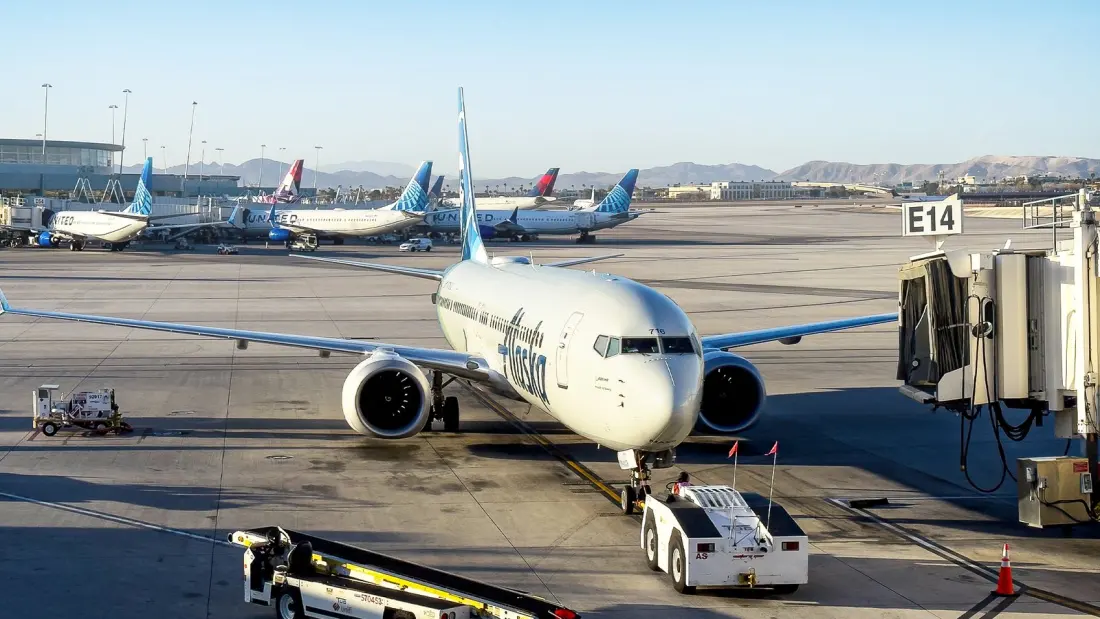
There's a quirk in commercial aviation that most passengers never notice: a fully loaded Boeing 737 MAX can legally sit at the gate heavier than it's allowed to take off. The trick is a small regulatory gap between two certified limits, and it has real consequences for your flight time, cabin comfort and ticket price.
Aircraft carry two weight figures. Maximum Taxi Weight covers slow rolling on the ground, where only the landing gear bears the load — for a 737 MAX 8 that's 182,700 pounds (82,871 kg). Maximum Takeoff Weight, which applies once the jet accelerates down the runway, is 500 pounds lower, at 182,200 pounds (82,644 kg). That gap exists because takeoff demands far more of the airframe: the brakes must be able to stop a rejected takeoff, and the plane must be light enough to climb away on a single engine if one fails.
Airlines exploit the difference deliberately. On packed flights, dispatchers load the jet to its full takeoff limit with flight fuel and reserves, then add roughly 500 pounds of extra 'taxi fuel' on top. During the normal 12-minute taxi to a busy runway, the engines burn around 20 pounds per minute — enough to bring the aircraft legally under the takeoff limit by the time it lines up.
The system only works when ground traffic behaves. If air traffic control offers a fast shortcut to the runway and the taxi takes under four minutes, the jet arrives still hundreds of pounds too heavy. Crews then have to decline the takeoff clearance or park on a concrete pad and burn off the surplus with throttles and air conditioning running — wasting fuel and a runway slot because they got there too early. In worse traffic jams, if the buffer burns through and starts eating into flight reserves, pilots may have to return to the gate for more fuel.
The narrow 500-pound margin is partly a Boeing design constraint. Airbus gives its A320neo an 882-pound cushion (nearly double on the A321neo). The MAX ended up about 7,000 pounds heavier than the previous 737 generation thanks to bigger engines and structural reinforcement, squeezing Boeing's flexibility on the aging 1960s-era airframe.
Why should travellers care? Because flying the MAX at maximum weight on long cross-country routes carries comfort trade-offs. Its classic aluminium fuselage can't handle higher cabin pressurisation, so at cruise you experience the equivalent of about 8,000 feet — versus roughly 6,500 feet on newer rivals — which many people feel as extra fatigue after landing. Moisture limits also mean cabin humidity can drop to around 10%, drier than most deserts, on five-hour sectors. The upside: airlines can squeeze nearly 180 passengers plus coast-to-coast fuel onto a single-aisle jet, keeping fares competitive. So next time your 737 MAX sits at the end of a taxiway with engines spooling, it may literally be losing weight before takeoff.