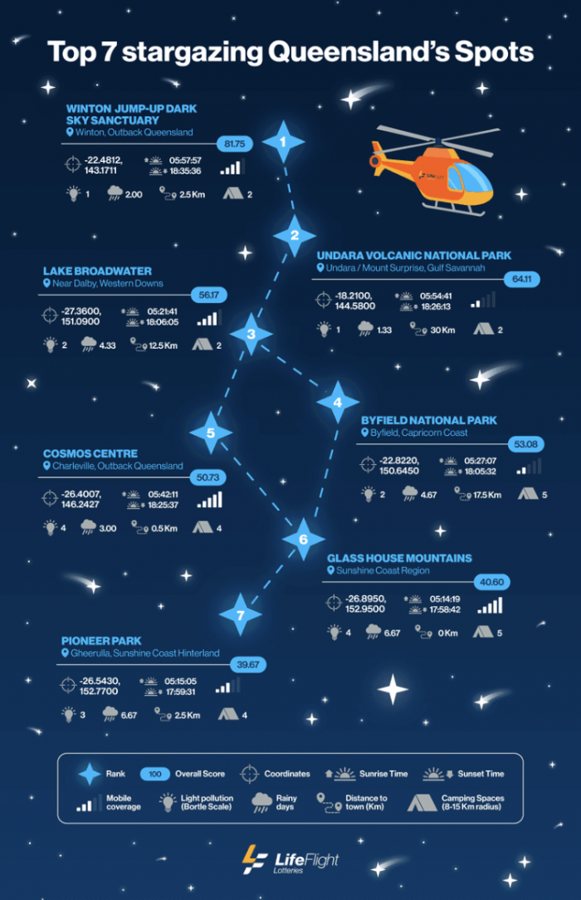
Interest in astro-tourism has doubled, with searches for the term 'astrotourism' up 100%, and new research from LifeFlight Lotteries has ranked Queensland's seven best places to see the night sky. The scoring weighed light pollution (via the Bortle Scale), spring rainfall, how easy each spot is to reach, mobile coverage and nearby camping.
Taking first place with a score of 81.75 out of 100 is the Winton Jump-Up Dark Sky Sanctuary in Outback Queensland. It earned a Bortle Scale rating of 1 — the darkest classification there is — and averages just two rainy days in spring. Winton is also famous for its dinosaur fossils, so you can pair ancient footprints with ancient starlight in one trip.
Second place went to Undara Volcanic National Park in the Gulf Savannah (64.11), where some of the state's darkest skies sit above one of the world's longest lava tube systems, formed around 190,000 years ago. Arrive at dusk and you'll catch thousands of microbats pouring out of the caves before the stars take over. It's a Bortle 1 site too, with only 1.33 average rainy spring days, though the nearest town is 30km away.
For an easier weekend, Lake Broadwater on the Western Downs ranks third (56.17). It's the region's only naturally occurring freshwater lake, has a Bortle 2 rating, solid mobile coverage and sits close to Dalby — handy for campers and birdwatchers. Byfield National Park on the Capricorn Coast (53.08) mixes rainforest, huge sand dunes and secluded beaches, and is only 17.5km from the nearest town.
If you'd rather have experts do the pointing, Charleville's Cosmos Centre ranks fifth (50.73). It's a well-known name in Australian astronomy, just 500 metres from town, with guided stargazing sessions under Outback skies. Nearer to Brisbane, the Glass House Mountains (40.60) offer dramatic volcanic peaks as a foreground for astrophotography, while Pioneer Park at Gheerulla in the Sunshine Coast Hinterland (39.67) rounds out the list with camping, walking trails and Bortle 3 skies — an easy first taste of dark-sky chasing for south-east Queenslanders.
Because most of these spots are regional or remote, LifeFlight has some sensible safety advice. Tell someone your plans and expected return, check road conditions and the forecast, and pack water, food, warm layers (outback nights get cold fast), a first aid kit and a good headlamp. Mobile reception can disappear quickly, so download offline maps and consider a personal locator beacon or satellite device if you're heading beyond coverage. Watch for wildlife on country roads after dark — arriving before sunset is the smart move — and camp in designated areas with minimal artificial light, both for your own safety and to keep the skies dark.
Who's this for? Anyone who wants a genuinely dark sky without leaving Australia. Dedicated astronomers should aim for Winton or Undara; families and first-timers will find Charleville, the Glass House Mountains or Lake Broadwater far more forgiving, with facilities, phone signal and shorter drives.