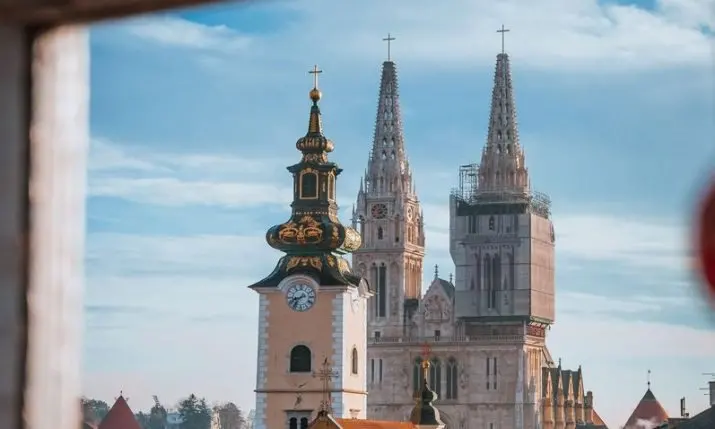
Zagreb's earthquake-scarred cathedral is giving up secrets. As restoration crews repair the damage from the March 2020 earthquake that hit the Croatian capital, archaeologists and art historians working on the building have made a string of new discoveries, unveiled at a scientific conference in Zagreb on 14 and 15 October titled Artistic Treasures of Zagreb Cathedral – New Research.
The headline find: four previously unknown fragments from a Renaissance tombstone belonging to Luka of Szeged, a former Bishop of Zagreb. According to Danko Zelić, deputy director of the Institute of Art History, the pieces have dramatically improved researchers' picture of what the monument originally looked like, allowing a fuller reconstruction. Art historian Milan Pelc has published a scientific paper on the discovery.
The conference also cast fresh light on the cathedral's medieval wall paintings. Researchers from the Croatian Conservation Institute, Krasanka Majer Jurišić and Kristina Krulić, have re-examined the frescoes in the old sacristy, which date from the third quarter of the 13th century under Bishop Timotej. They are considered the oldest surviving wall paintings in Zagreb. A key scene, a Last Judgement on the western wall, was lost forever in 1882 when architect Hermann Bollé demolished that wall during earlier restoration works — it survives only in a watercolour sketch made shortly before its demolition. The cathedral, badly damaged by an earthquake back in 1880 as well, has been rebuilt and altered so many times that separating its original medieval fabric from later additions is a research project in itself.
The two-day gathering drew 27 authors presenting 25 papers from scientific, cultural and Church institutions. Monsignor Zlatko Koren praised the Croatian restoration experts, saying international specialists had recognised their work, and argued the results deserve an audience beyond Croatia. Organisers hope the conference becomes an annual international event, and Zelić has called for a comprehensive scientific monograph on the cathedral — remarkably, one doesn't yet exist for a building of this importance.
Why should a traveller care? If you're wandering Zagreb's Upper Town and its twin-spired cathedral, you're looking at a building that's still actively revealing its past. The post-earthquake works mean parts of the site are changing — scaffolding comes and goes, but so do fresh insights, exhibitions and eventually more of these finds going on display. It's a good moment to appreciate the structure as a living archive rather than a fixed monument, and the conference work may well feed into better signage, publications and visitor material in the coming years. Zagreb itself rewards a slow visit: the cathedral sits a short walk from Ban Jelačić Square, with the Dolac market, Upper Town funicular and Museum of Broken Relationships all within easy reach. Keep an eye on the Institute of Art History's project on continental Croatia's artistic heritage — it signals more research and public events to come.