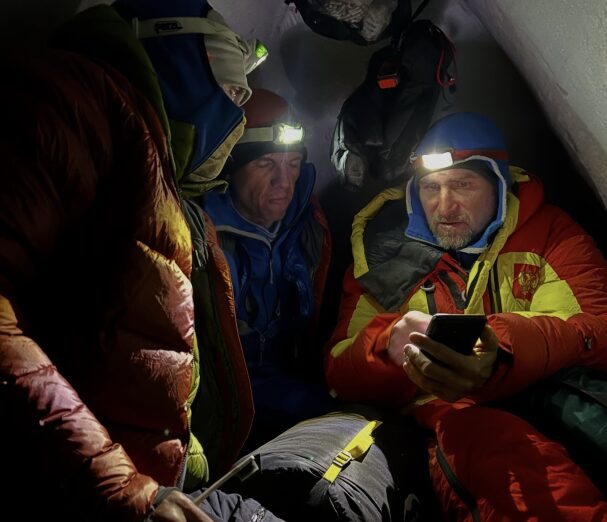
A small Russian team is currently the only one climbing on any 8,000-metre peak, and they've chosen one of Everest's hardest challenges: the West Ridge, in lightweight style, without supplemental oxygen and without a support crew.
The expedition began with a tense approach to the Lho La, the col below the West Ridge. Climber Serguey Kondrashkin described a route threading beneath massive hanging seracs. The team picked their way up having spotted no avalanche debris, but after pitching camp on the col, the boom of a serac collapsing somewhere below was a stark reminder of what hangs over that ground. They've since found a better line that cuts time spent in the danger zone.
From the Lho La, the climbing turned sharp: a 50-degree snow slope, then over 100 metres of 60-degree glacial ice before topping out on the ridge itself. Teammates Andrei Vasiliev and Vitaly Shipilov pushed up a rocky outcrop to scout a line and a possible campsite, photographing the terrain ahead. Kondrashkin, watching from below with Natalya Belyankina, wrote that the scale of Everest's upper half made them feel like they were standing at the very foot of the mountain.
The team then dealt with a blow. Belyankina, already struggling with a painful Khumbu cough, was airlifted from the mountain after it became clear she couldn't continue. Leader Andrei Vasiliev called it a real loss, noting how much she had done to make the expedition happen. That leaves three — Vasiliev, Kondrashkin and Shipilov — heading back up for roughly a week.
Their goal is one of the most ambitious on Everest in recent years. The West Ridge has only been climbed three times, each by a different variation, and all were serious undertakings. There are two ways to do it: a long grind along the ridge itself from the Nepali side, as a Yugoslavian team did in 1979 with climbers including Andrej Stremfelj and Nejc Zaplotnik; or crossing into Tibet partway and finishing up the North Face via the Hornbein Couloir — the line Americans Tom Hornbein and Willi Unsoeld forged in 1963, climbing the standard route to Camp 2 before joining the West Ridge.
The Russians haven't committed publicly to which variation they'll take, adding to the raw, exploratory feel of this climb. No fixed ropes from commercial expeditions, no bottled oxygen, no Sherpa support — just three climbers working out the route as they go.
For travellers, this is a reminder that Everest still holds genuine unknowns, even as the normal route draws crowds each spring. If the mountain fascinates you, the trek to Everest Base Camp passes the Khumbu Icefall and offers views toward the Lho La and the western approaches — you can watch history being attempted from a safe, stunning vantage point.
Story via ExplorersWeb.