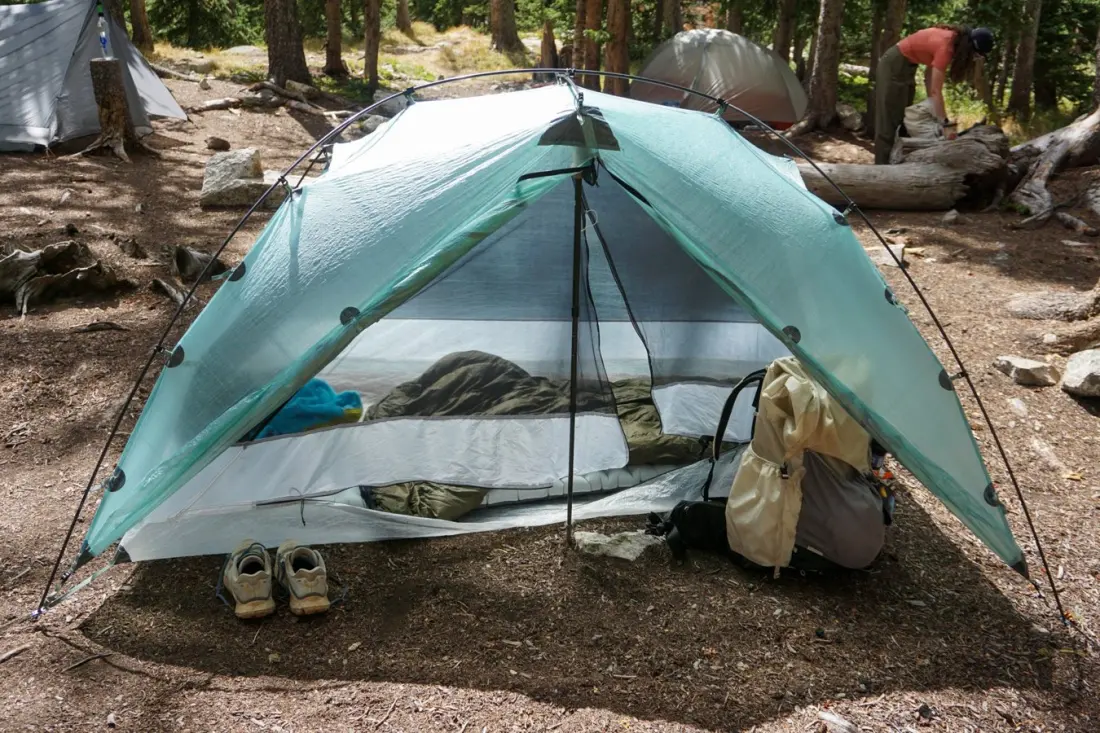
Freestanding tents have always come with a compromise: convenience at the cost of extra weight. Durston Gear's new X-Dome Pro 1+ is trying to end that trade-off, claiming the title of the world's lightest freestanding double-wall tent at just 1 lb 11.5 oz (under 800 grams). It costs $849, which stings, but the spec sheet explains the price.
The Pro version swaps the standard X-Dome's silpoly fly for Dyneema Composite Fabric, a material that is famously light, fully waterproof and absorbs no water at all. In testing, the reviewer found the tent could be shaken almost dry in the morning, so you're never packing soggy fabric. The poles are all carbon fiber with matching carbon-composite inserts at the joints, removing the metal fittings that typically bend or corrode over time. Seams are heat-bonded rather than sewn and taped, so there are no needle holes to let water in.
Design-wise, the tent pitches with poles alone — no stakes required in theory, which matters on granite slabs, wooden platforms or sand where staking is a nightmare. Twelve guyout points and side pockets that accept trekking poles let you reinforce it; Durston says a pole-braced setup handles winds above 60 mph. The fly and mesh inner can be pitched separately as a tarp-and-net combo, though the reviewer admits most people will just leave them clipped together to keep camp chores quick.
Real-world performance held up well. A redesigned door and a tightly woven strip along the tent's base eliminated the rain splashback that plagued the earlier X-Dome 2, and the door stayed open in moderate rain without water pouring in. Inside, the 23.5 sq ft floor and offset parallelogram geometry felt genuinely spacious — the tester, 5'10", slept comfortably with a wide pad, a full pack, shoes and an umbrella, all inside. One caution from testing: in strong gusts, the tent warped and nearly blew away until it was staked, so treat stakes as essential, not optional.
There are trade-offs to know about. DCF is stiff and resists compression, so the packed size is bulkier than a silpoly equivalent, and long-term abrasion will eventually create pinholes even though Dyneema resists tearing. The modular pitch, while clever, is fiddly enough to discourage nightly use. And the $849 price is a steep jump over the standard fabric version for the modest weight savings — arguably the biggest question mark for most buyers.
So who is this actually for? Solo backpackers and long-distance hikers who want a true freestanding double-wall — ventilated, condensation-resistant, quick to pitch anywhere — without lugging a pole-heavy tent. It's pitched as a 3+ season shelter: fine for shoulder-season snow and wind, not intended for serious winter mountaineering. With only one vestibule and a snug fit for two, it's best treated as a roomy one-person home on trail. If that describes your trips and your budget stretches to it, this is arguably the new reference point in its category.