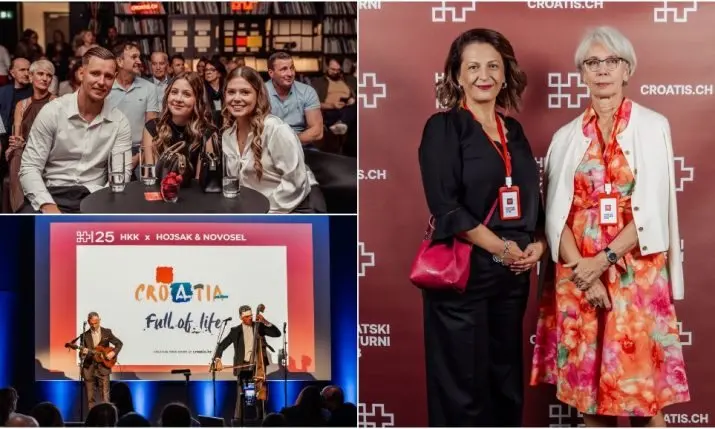
More than 100 people packed into the schwarzescafé at Zurich's Löwenbräukunst art complex on a September Saturday to mark a milestone that few volunteer clubs reach: 25 years of the Croatian Cultural Club (HKK) in Switzerland's biggest city.
The evening blended formal thanks with genuine entertainment. Certificates of appreciation went to long-standing partners, including the Croatian Embassy in Switzerland, the Central State Office for Croats Abroad, and sister associations Udruga Slavonia Zürich, NK Croatia Zürich and KUD Silvije Strahimir Kranjčević Zürich. A special award recognised Dr Vesna Polić Foglar, longtime editor of the club's Libra magazine.
The musical highlight came from the instrumental duo Hojsak & Novosel — Tihomir Hojsak on double bass and Filip Novosel on tambura, a traditional Croatian stringed instrument. Their set mixed folk roots with contemporary arrangements and improvisation, which is very much the club's style: keeping Croatian culture alive abroad without letting it feel like a museum piece.
HKK president Antonela Grill Zečević summed up the club's evolution with a telling line about having to change in order to survive, adapting to new generations while keeping the community at the centre. Representatives of the Croatian state were out in force too, from the Consulate General in Zurich to a newly arrived diplomat from the Bern embassy, underlining how much official weight sits behind grassroots diaspora culture.
The club's 2026 programme has already included a stand-up show by Saša Turković in Baden and the traditional Croatian Statehood Day picnic, with the anniversary night as its centrepiece. The event ran with backing from the Central State Office for Croats Abroad, sponsorship from Atlantic Grupa and support from Croatia Airlines.
Why should a traveller care? Because Zurich's cultural calendar goes well beyond the usual galleries and lakeside strolls. If you're in the city and fancy hearing a tambura rather than an alphorn, or want a taste of how strongly Croatian identity thrives in Switzerland, HKK's events are open, friendly and often free or cheap. The Löwenbräukunst complex in Zurich-West, where the anniversary was held, is itself worth a detour — a contemporary art hub in the city's most interesting industrial district, with cafés and galleries that make an easy afternoon.
For Croatians living in or visiting Switzerland, the club is a ready-made network; for everyone else, it's a reminder that some of the best cultural discoveries in a foreign city come from communities that keep their traditions loud, modern and welcoming.