A travel writer at Frommer's has a ritual: every trip with her dog-obsessed friend Rachel produces as many photos of local pups as of landmarks. Strike up a chat with a dog owner in Taipei or Lyon and you get a crash course in how pets fit into daily life somewhere new. Now there's data to back up what you'll spot on the street.
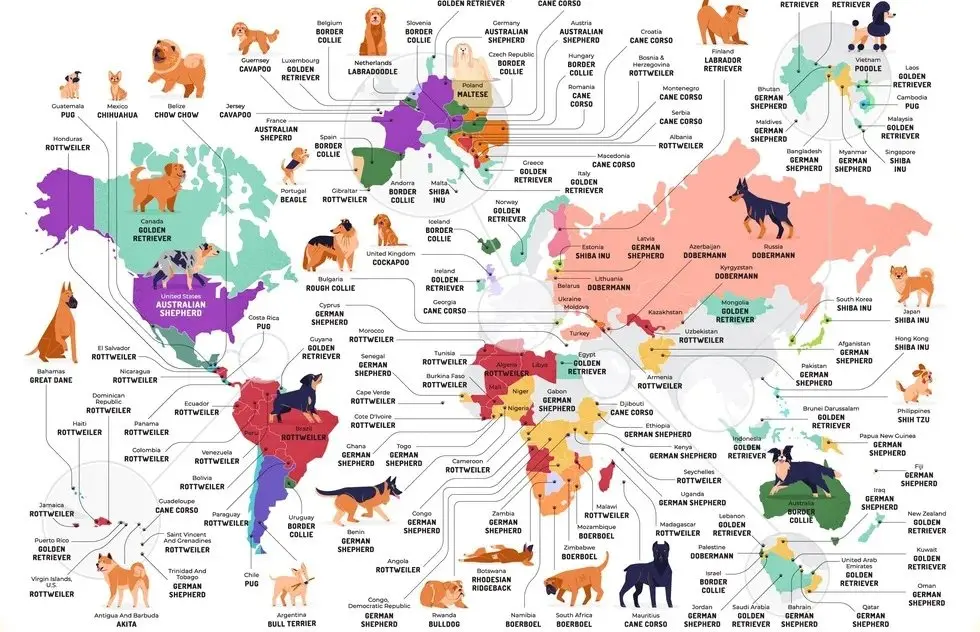
Household Quotes, a British site that normally pairs homeowners with builders, turned its attention to pets and built a set of world maps showing each country's most-searched dog breed. The results are based on Google search interest rather than official registrations, which makes it a rough mood ring of what people are curious about, not a census of actual households. Still, the patterns are fun to read as you plan where you might meet a particular breed on your travels.
The rottweiler comes out on top in more countries than any other breed: 34 in total. The thinking is that this is an ancient working dog, possibly herding livestock as far back as Roman times, and its popularity stretches across large swaths of the globe. But add up total worldwide searches and the Australian shepherd wins outright. In a twist, the breed isn't even Australia's favourite. That honour goes to the border collie.
Some results are exactly what you'd predict. Mexico's top breed is the chihuahua, which makes sense for the birthplace of the tiny dog. Others defy stereotype: the poodle, so long associated with France, no longer leads there. The French have fallen for Australian shepherds, just like Americans. Meanwhile poodle mania lives on in Vietnam, a former French colony, which is one plausible route the breed took to Southeast Asian popularity.
Regional loyalty shows up too. South Africa's boerboel, a heavyweight mastiff-type traditionally used as a guard dog, is the number one breed at home and in neighbouring Namibia, and nowhere else much. The cane corso, another Roman-era breed, dominates across the Balkans and Eastern Europe, while Italians themselves have moved on to golden retrievers. So the picture shifts border by border, which is half the charm.
Why should a traveller care? Because dogs are one of the easiest conversation starters on the road. If you're the type who ends up petting every dog in a plaza, knowing that Montenegro is cane corso country or that Vietnam is poodle paradise adds a small, delightful layer to a trip. It also tells you something about each place: working-dog breeds cluster where guarding and herding remain part of rural life, and companion breeds flourish in cities. Rachel's approach, greeting dogs and their humans everywhere she goes, turns out to be a genuinely good travel technique. You meet locals, get recommendations, and come home with a camera roll full of friends you can't call.