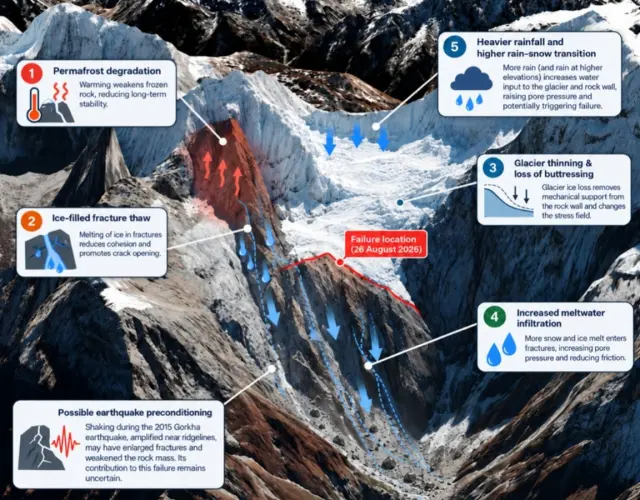
When floodwaters tore through the Rasuwa–Nuwakot districts of central Nepal, they took more than homes and roads. The flood swept away 21 temples, shrines and cremation sites entirely, with many more left damaged, foundations undercut and courtyards buried in silt. Some of the region's priests, caretakers and elders — the people who held its traditions — were killed too.
There is one fragile consolation: much of what stood there had already been recorded. The Nepal Heritage Documentation Project, led by Heidelberg University with Nepal's Department of Archaeology and the Saraf Foundation, had spent years surveying the area and documented more than 80 temples, shrines and cremation sites along the river. The wider project, backed for eight years by the UK-based Arcadia and coordinated with UNESCO, grew out of the 2015 earthquake response and has catalogued over 2,000 monuments across Nepal. That database — which records not just dates and photographs but the rituals, cult groups and living practices attached to each site — is now the only surviving record of much of what was lost.
The practical work has already begun. The Nuwakot Museum is planning to match recovered statues, ritual objects and fragments back to their original locations, using the documentation the way investigators match recovered belongings to the missing. When rebuilding eventually starts, the records will show where each deity was housed and where swept-away inscriptions and images once sat.
What makes this story resonate beyond Nepal is what these buildings actually were. The temples along the river weren't museums — they were active houses of deities, worshipped daily with lamps, offerings and processions. The riverbanks themselves carried cultural weight: cremation ghats lined the water, and the same geography that made the area sacred made it dangerously exposed. When a ghat disappears, funeral and mourning rites tied to that exact spot lose their anchor — right when grieving communities need them most.
The region sits on ancient trade routes linking India, Nepal and Tibet, with a mixed Hindu and Buddhist fabric threaded with shamanic and folk practice. Yet communities are improvising. With bodies unrecoverable, families asked whether a sacred grass effigy could stand in for the missing dead at the pyre. One survivor trapped for nine days in a collapsed tunnel recited mantra continuously. Ritual life here is not decoration; it's how people endure and mourn catastrophe.
For travellers, the takeaway is a sobering one. The heritage that makes Nepal's mid-hill valleys extraordinary is living, community-held and increasingly climate-vulnerable. Respect it as such: these are places of worship, not backdrops. And if you visit areas touched by disaster, patronising local lodges, guides and craftsmen is a direct way to help communities hold on while they rebuild. The Rasuwa flood is also a quiet argument for documentation of all kinds — photographs, oral histories, family albums — because sometimes the record becomes the inheritance.