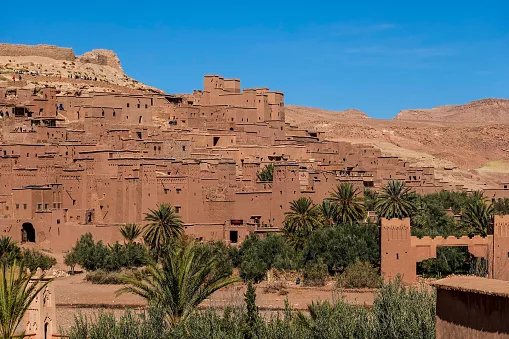
An hour's drive northwest of Ouarzazate, the fortified village of Aït Benhaddou rises out of the Ounila Valley in a shade of ochre that matches the hills around it almost exactly. That's no accident of paint — the entire ksar, a traditional pre-Saharan fortified settlement, was built from the earth beneath it: mud shaped into sun-dried bricks and compacted into thick walls that keep out the desert heat by day and hold warmth through cold nights.
Listed by UNESCO since 1987, the village grew wealthy as a trading post on caravan routes linking the Sahara to Marrakech, with merchants and their animals sheltering at a caravanserai nearby. The buildings standing today mostly date to the 17th century or later, but the building traditions behind them are far older. Inside the walls, life was organised around defence and shared resources: high ramparts, corner towers, a controlled entrance, communal spaces and religious buildings, with grain threshed outside the boundary.
Walking the site is the whole point. Narrow lanes climb the hillside between modest homes and grander fortified residences with decorative geometric brickwork and projecting towers, ending at viewpoints over the valley and river. Film fans may recognise the silhouette from various big-screen productions, but the real appeal is close up — the texture of the walls and the way the settlement follows the contours of the land.
There's also a conservation story travellers should know. Earthen architecture is fragile: once a protective surface fails and water gets in, walls deteriorate fast. Many residents long ago moved to modern housing across the river, and the September 2023 earthquake damaged historic buildings across the region. In a 2026 decision, UNESCO welcomed structural assessments and the start of restoration works at Aït Benhaddou, while urging better coordination, visitor management and a clearer management structure. The heritage body CERKAS monitors and supports conservation across the Atlas and sub-Atlas zones.
For visitors, that translates into a few simple courtesies: wear shoes that can handle uneven, steep paths, respect barriers and closed buildings, take things slowly rather than racing for the photo spot, and hire local guides or spend with local businesses so tourism dollars stay in the community. Pressure from commercial activity and guest accommodation is a real concern for a site that is still, in theory, a living village rather than a film backdrop.
Anyone road-tripping through southern Morocco — between Marrakech over the High Atlas and the Sahara — will pass close by anyway, and the ksar pairs naturally with Ouarzazate's studios and kasbahs. Go with a bit of patience and curiosity about how the place was actually built, and it rewards far more than a quick snap from the riverbank.