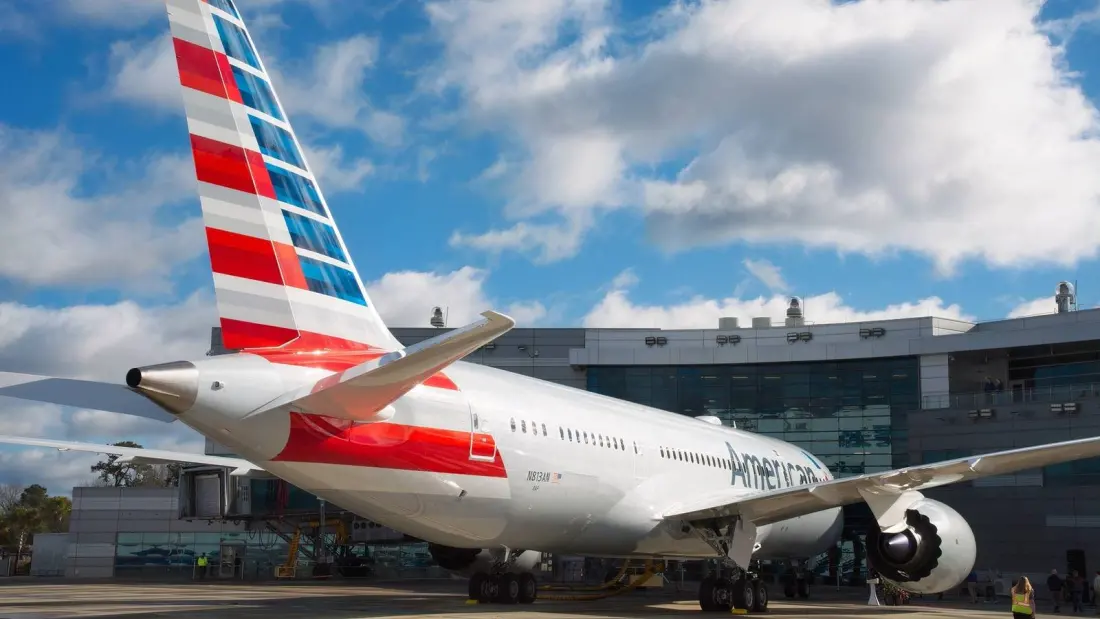
The Boeing 787 Dreamliner arrived more than two decades ago with a feature that felt like science fiction: windows that dim at the push of a button instead of a plastic shade. Twenty years on, that same feature has turned into an expensive maintenance problem, and American Airlines is reportedly replacing the windows on its oldest 787s, according to aviation insider JonNYC.
The issue is wear and tear, but not the kind you'd expect. Passengers keep hammering the dimming button because the electrochromatic glass doesn't react instantly. It can take over a minute for a window to go from fully bright to dark, so people press repeatedly and fast, breaking the controls. There's another wrinkle: cabin crew can lock out the dimming function entirely, often to black out the cabin on overnight flights. Passengers get no warning that their button is dead, so they press harder and more often, making things worse. Each replacement reportedly runs around $5,000 per window — across a large fleet, that adds up fast.
The windows themselves are clever. At 10.7 by 18.4 inches, they're the biggest in the sky, built from three layers: the structural outer pane, a middle electrochromatic panel that does the dimming, and an interior plastic cover. The middle panel uses a gel that darkens as higher voltage passes through it. Early versions couldn't go fully dark and were slow to change, but software updates have since added near-total blackout and quicker transitions.
American operates 70 Dreamliners — 37 of the smaller 787-8, which it started flying in early 2015, and 33 of the longer 787-9, delivered from May 2016 onwards. Its newest 787-9 arrived in April 2025, with 19 more on order. It's the oldest aircraft, those early -8s and -9s, that are reportedly in line for new windows.
For travellers, this matters more than it might sound. If you fly long-haul in economy on American, the window is your one piece of personal territory, and a broken dimmer either blasts you with 35,000-foot sunlight or leaves you staring at a window you can't control. Newer windows should mean fewer locked-out buttons and less mid-flight friction over who gets shade. There's also a subtle perk: because dimmable glass lets light through partially, you can block glare while still keeping a view — a decent compromise in the eternal blinds-up versus blinds-down stand-off.
The 787 is becoming the long-haul workhorse of every major US carrier. United flies all three variants, Delta has ordered 30 of the biggest 787-10 with options for 30 more, Alaska is taking 787-9s with new lie-flat business suites, and even Southwest is rumoured to be eyeing the type for its first proper long-haul routes. American is the latest reminder that even the flashiest cabin tech needs to survive actual passengers.
If your next American long-haul is on a Dreamliner, don't be surprised if the windows look and behave better than you remember — and go easy on that button. The glass needs time.