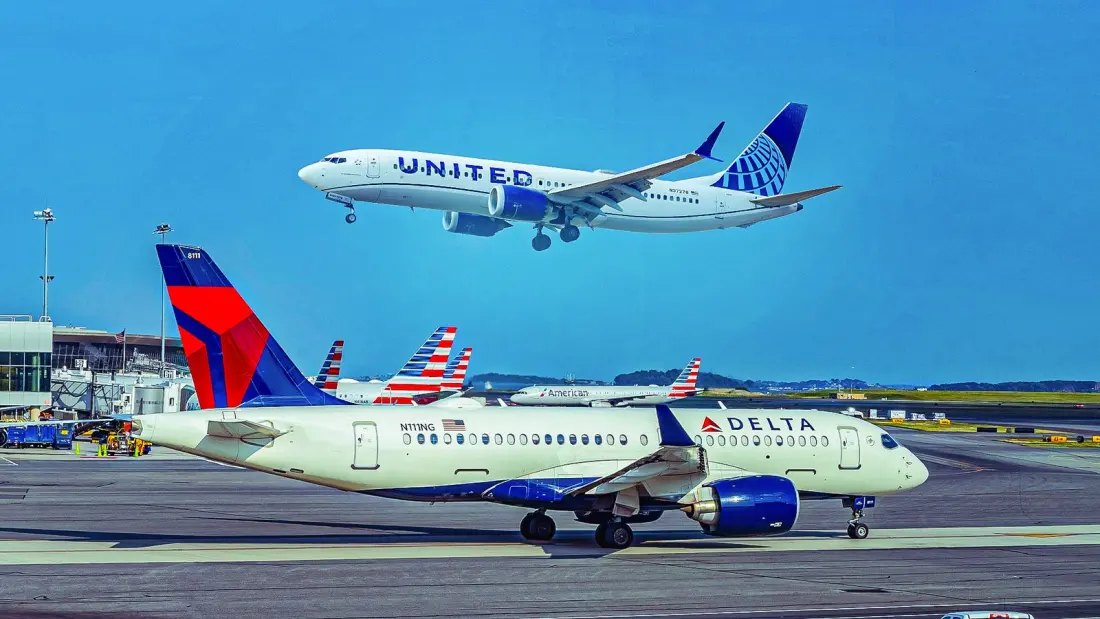
If you've ever been offered a choice between flights and spotted one plane listed as an A220 and the other as a 737 MAX, there's a decent case for picking the Airbus. A closer look at the two narrowbody families shows the A220 generally wins on passenger comfort — though the 737 MAX is catching up, and availability still favours Boeing by a wide margin.
The fair fight is between the largest A220, the -300, and the smallest 737 MAX, the MAX 7. They chase similar short-to-medium haul routes, but they're built differently. The A220 was designed from scratch by Bombardier around a 2-3 seating layout, while the 737 MAX still carries the DNA of a 1960s design squeezed into a 3-3 cabin. That matters: even though the MAX's fuselage is actually wider (3.8m vs 3.5m), the A220's smaller cabin means fewer seats per row, so airlines can fit wider seats. Delta's A220 main cabin seats measure 18.6 inches across versus 17.3 inches on its 737s — nearly an inch and a half of extra hip room.
The 2-3 layout has another underrated perk: fewer middle seats. On Delta's 109-seat A220-100s, only about 17% of passengers get stuck in the middle, compared to 30% on its 737s. More people get a window, aisle access, or both armrests. Then there are the windows — the A220's 11 by 16-inch portholes are bigger than even the Boeing 777's, positioned at eye level so you don't have to slump to see out. The cabin is also among the quietest in commercial aviation, with a noise footprint up to 50% smaller than previous-generation aircraft.
That's not to say the 737 MAX is a bad place to sit. It's a huge improvement on the 737s that came before it, with a 50% noise reduction versus the older 737-800, 20% better fuel burn, bigger overhead bins and mood lighting. But Boeing was boxed in by the original airframe's dimensions; Airbus started with a blank sheet.
The catch? You're far more likely to fly on a MAX. Boeing has delivered around 2,440 of them against roughly 550 A220s. Carriers like Ryanair and Southwest fly nothing but 737s, while dedicated A220 operators are rarer — Breeze Airways and Latvia's airBaltic are the only all-A220 airlines so far. The MAX 7 has only just been certified, and the MAX 10 is still awaiting approval.
For travellers, the practical takeaway is simple: if a route search shows both a 737 MAX and an A220 option at similar prices, the A220 is usually the more pleasant couple of hours — more seat width, better windows, less noise. Just remember that the airline matters too; a well-configured 737 with a good carrier can still beat a cramped A220. But all else being equal, the newer design has the edge.