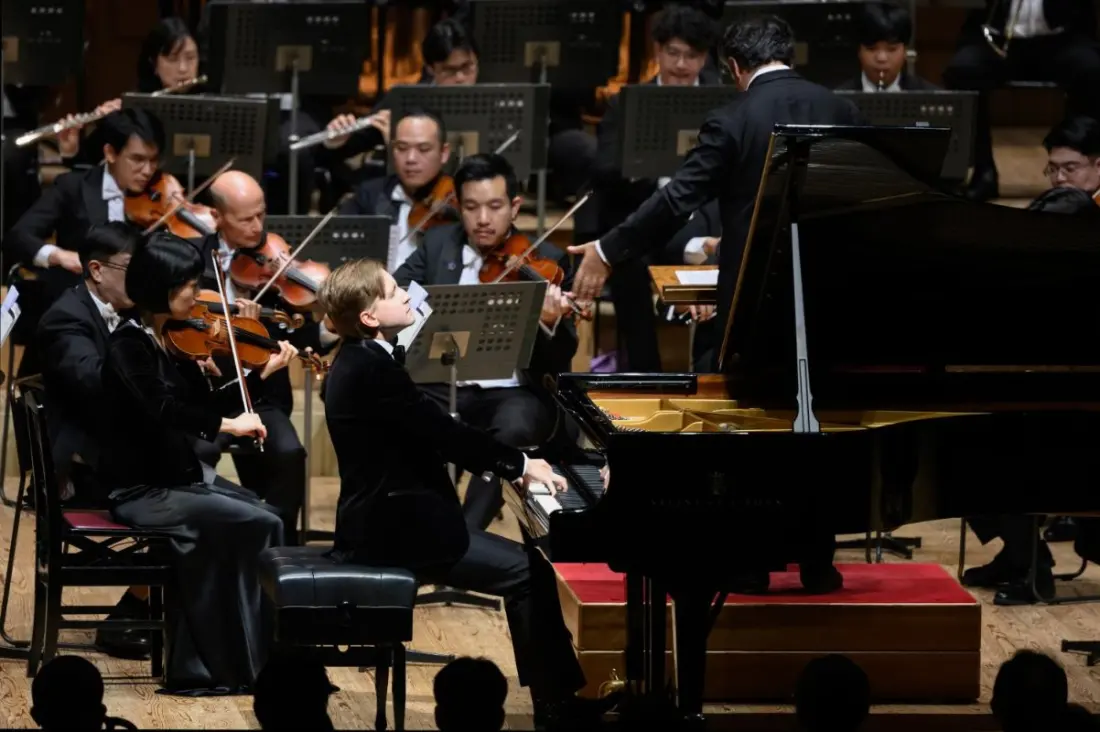
Thailand's Royal Bangkok Symphony Orchestra (RBSO) has just wrapped a tour of Japan that ended with a slot at Asia Orchestra Week 2026 — and it turned out to be more than a series of concerts. Across eight days in October, the orchestra played Tokyo and Kanazawa, teamed up with a Japanese ensemble, and made a detour that had nothing to do with ticket sales: a school visit in the part of Japan still recovering from a major earthquake.
The tour opened on 5 October at Sumida Triphony Hall in Tokyo, with Armenian conductor Sergey Smbatyan on the podium and Russian pianist Dmitry Masleev as soloist. The programme was a deliberate mix: Narongrit Dhamabutra's Siam Soundscapes, a contemporary Thai work, sat alongside Rachmaninoff's Piano Concerto No.2 and Dvořák's Symphony No.8. It was a statement as much as a setlist — Thai composition and Thai players presented on equal footing with core orchestral repertoire.
From Tokyo the orchestra moved to Kanazawa, the cultured capital of Ishikawa Prefecture on the Sea of Japan coast. Before the main concerts, RBSO musicians travelled to Wajima Junior High School on 7 October, in the Noto Peninsula area badly hit by the January 2024 earthquake, and played for students and local residents. It was the tour's most human moment, and it set up the concerts that followed.
On 8 and 9 October, RBSO shared the stage at Ishikawa Ongakudo with Orchestra Ensemble Kanazawa, one of Japan's respected chamber orchestras. The 8 October programme carried real weight for the local audience: Shin'ichirō Ikebe's Pray For The Light, written as a requiem for the victims of the Noto Peninsula earthquake, plus his symphonic poem The Way Of Fertility, paired with Mozart's Symphony No.35. There was lightness too — a Star Wars selection by John Williams, with Thai and Japanese musicians playing together under conductor Junichi Hirokami.
For travellers, the story is a nudge in two directions. Kanazawa remains one of Japan's most rewarding city trips — well preserved geisha and samurai districts, Kenroku-en garden, excellent seafood — and it now hosts meaningful international music collaborations at Ishikawa Ongakudo. And if you're in Bangkok, the RBSO's home season is a genuinely good evening out, with an orchestra that clearly punches above its weight internationally. Music-driven travel is a great excuse to see a city differently, and both cities deliver.
The tour also did the quieter diplomatic work that orchestras do well: building a working relationship between Thai and Japanese musicians that should produce more joint performances down the line.