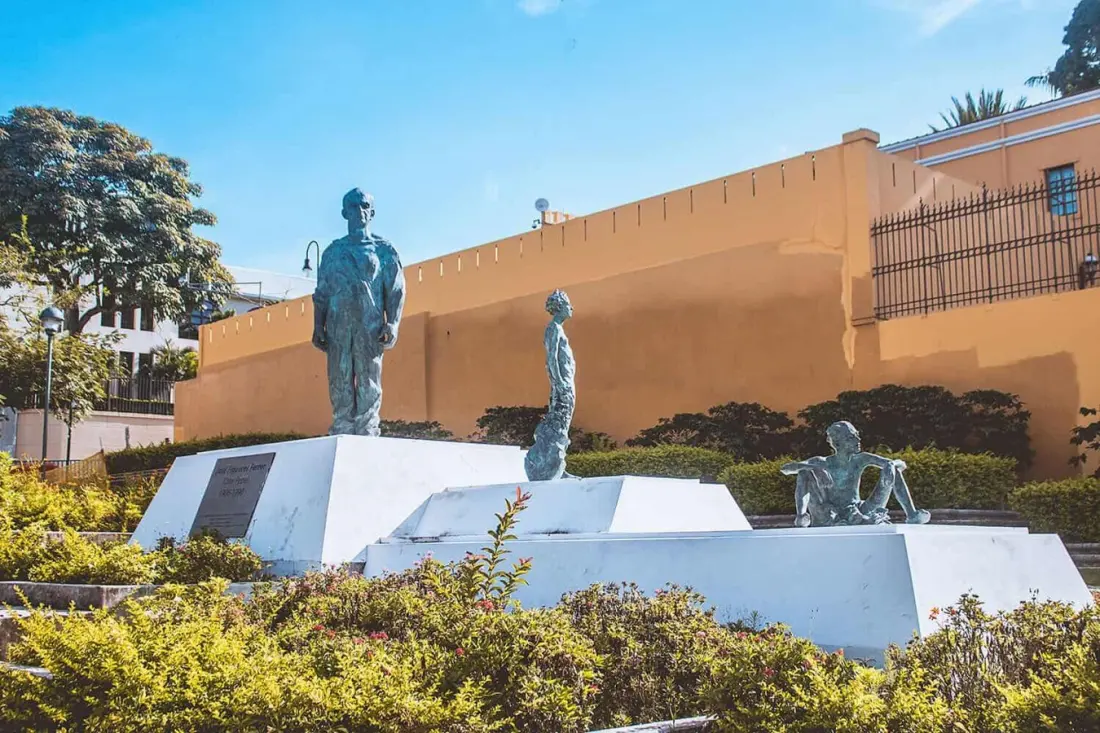
A familiar bronze figure has disappeared from one of San José's most symbolic squares. Costa Rica's Ministry of Culture and Youth removed the monument to former President José Figueres Ferrer — "Don Pepe" — from the Plaza de la Democracia on Friday morning, weeks before the country marks Army Abolition Day on December 1, the historic moment Figueres himself declared in 1948.
The removal is a conservation call, not a political demolition. Protesters clashing over budget cuts to public education had defaced the sculpture twice in recent weeks — first damaging its base in October, then hitting the bronze figures themselves with graffiti and spray paint after a student demonstration on the night of November 2. Culture Minister Jorge Rodríguez Vives said protecting national heritage could not wait, even while defending the right to peaceful protest. A crane crew moved the pieces to the National Museum's Pavas facility, where cleaning of the initial damage alone is expected to cost around 1 million colones (roughly $2,000), with no return date announced. Museum specialists have already cautioned that paint seeped into surfaces worn by age, so a perfect restoration isn't guaranteed.
The monument has a story of its own. Sculptor Marisel Jiménez Rittner created the ensemble, unveiled in April 1998: four bronze pieces showing Figueres, a girl with a violin symbolising culture, a boy with a book for education, and a sledgehammer recalling the abolition of the army. It has left the plaza before — taken into the National Museum's gardens in 2008 for renovations after the original sledgehammer was stolen, then reinstalled in December 2016 when the square was renamed Plaza de la Democracia y de la Abolición del Ejército.
Politically, it's a flashpoint. The National Liberation Party, which Figueres founded in 1951, has accused the government of erasing history and is demanding the restored statues return to the plaza. The National Museum has filed criminal complaints with investigators and prosecutors, and the minister has suggested those responsible should foot the bill. A traditional floral offering at the monument during Army Abolition Day ceremonies may have to happen without it this year.
For travellers, the practical takeaway is simple: the plaza beside the National Museum looks different right now, but the museum itself — the former Bellavista barracks where Don Pepe abolished the army — remains the richer stop. The empty pedestal is a window into a live national debate over protest, memory and public space, the kind of thing that gives San José its edge beyond postcard volcanoes and beaches. If your trip spans early December, the abolition commemorations will still be in full swing, monument or not.