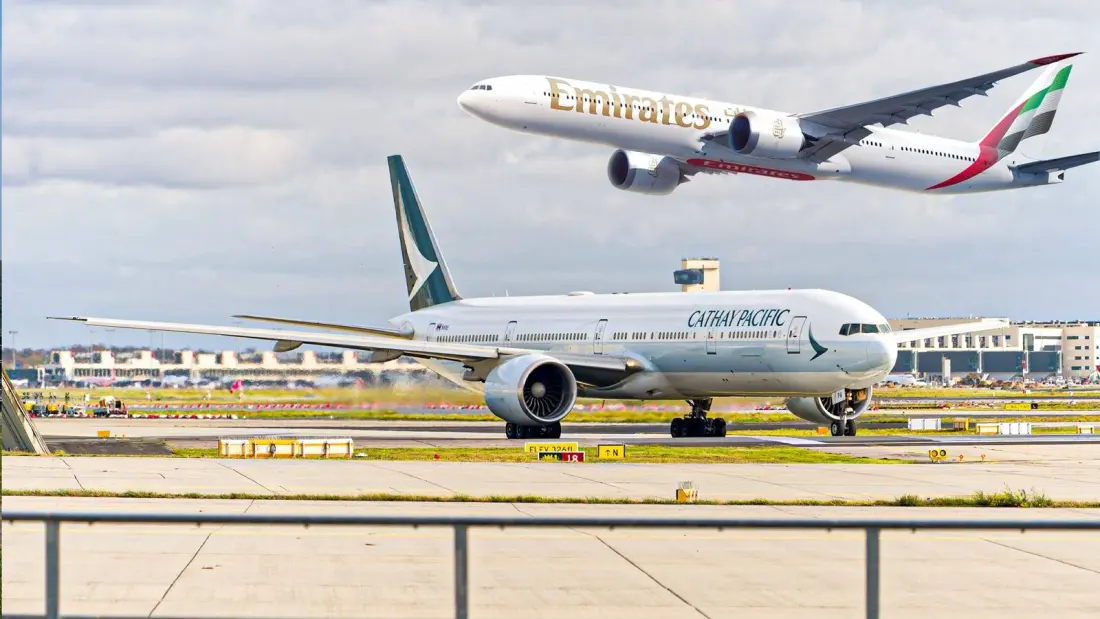
The Boeing 777-9 has racked up more than 600 orders without carrying a single paying passenger, and after years of delays the first deliveries are finally targeted for 2027. Lufthansa is slated to get the first jet, with Emirates expecting its own from the second quarter of 2027 and deliveries stretching to 2038. For travellers, this is the aircraft most likely to replace the workhorse 777-300ER — and the A380 — on long-haul routes through the 2030s.
The order book is dominated by Gulf and Asian carriers. Emirates leads with 270 777X commitments (235 of them 777-9s, boosted by a $38 billion Dubai Airshow deal in November 2025), followed by Qatar Airways with 124, Cathay Pacific with 35 and Singapore Airlines with 31. Lufthansa Group, British Airways' parent IAG, Korean Air and ANA are also in the queue.
What passengers actually get: roughly 426 seats in a typical two-class layout versus about 396 on the 777-300ER, a near-identical range of around 7,285 nautical miles, and new GE9X engines promising up to 10% better fuel burn. The most striking feature is the folding wingtip — a 71.8-metre span in the air that shrinks to fit standard airport gates on the ground.
The delay has created odd knock-on effects. Boeing built about 30 early airframes between 2019 and 2021 that are now technically outdated, and Emirates, Lufthansa and reportedly Qatar Airways have all refused some of them. Meanwhile, Airbus has been quietly winning over the same market: the A350-1000 has racked up 114 deliveries since 2018, and Air Canada ordered eight to replace its 777-300ERs from 2030. Notably, no North American airline has ordered the 777-9 at all.
For anyone booking long-haul flights, the practical takeaway is timing and route. Expect the first 777-9s on Lufthansa and Emirates trunk routes from 2027 onwards, with Singapore Airlines planning a new premium economy cabin around the type later in the decade. If you fly mega-hub routes — Dubai, Doha, Frankfurt — you'll see the new jet first. US and Canada travellers are likelier to encounter the A350-1000, which also promises a lower cabin altitude of around 6,000 feet versus 8,000 feet on the 777 family.
The next 18 months will tell whether certification holds and the delivery stream starts, or whether more airlines defect to Airbus. Either way, the 777-300ER — the best-selling long-haul widebody of its generation — will keep flying for years while its successor catches up.