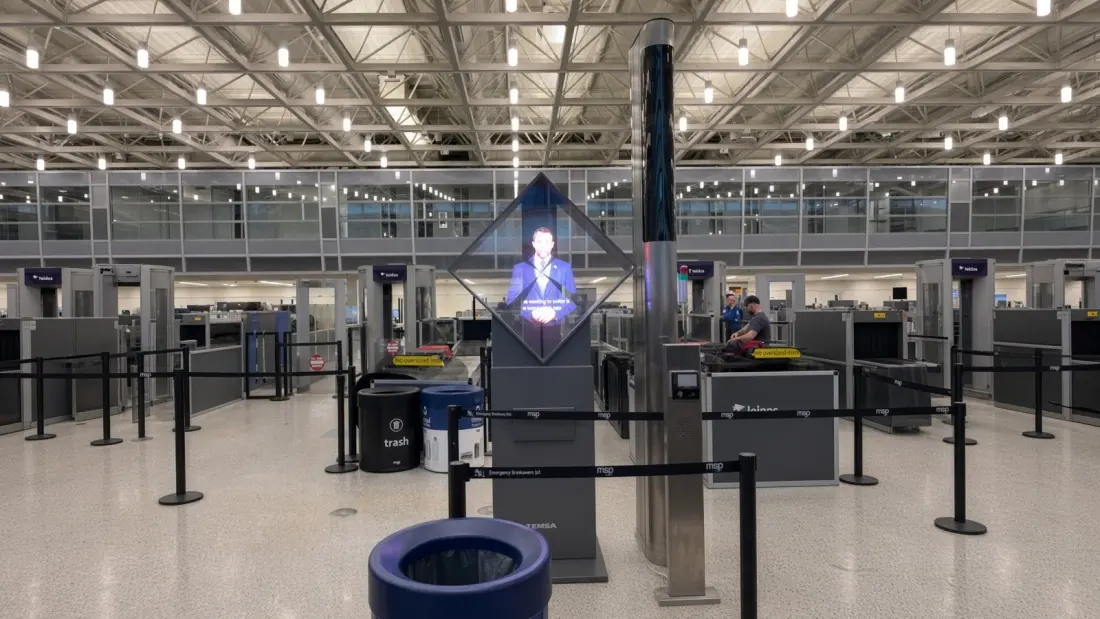
Travellers at Minneapolis–St. Paul have a new companion while they wait to take their shoes off: a floating, rotating image of Homeland Security Secretary Markwayne Mullin, projected on a pedestal-mounted display above the TSA checkpoint. The recording reassures passengers they probably aren't the cause of the delays, offers effusive thanks to President Trump, and signs off with "God Bless America."
It isn't an MSP one-off. A Chicago Tribune photograph from November 13 shows the same Mullin hologram looping at O'Hare, and one traveller there described the irony bluntly after being stranded during the nationwide ground stop: apparently there's money for holograms of cabinet secretaries, but not for a functioning air traffic control system. Complaints about Mullin checkpoint videos stretch back to at least mid-October, when a Charlottesville flyer flagged one crediting Trump with a "golden age of travel."
The tech behind it is less science fiction than it sounds. Campaign3D, the company behind the rollout, says it has deployed 50 Tensator Shard displays across 27 US airports, using HYPERVSN technology — essentially rapidly spinning LED blades that create the illusion of a floating image. The stated rationale is making security instructions, like keeping laptops in bags, more noticeable. In practice, critics note, practical instructions and political messaging are sharing the same screen, in a setting passengers cannot simply walk away from.
That compulsory audience is the sticking point. TSA creates the captive crowd; advertisers already pay for access to it via bin ads and screen placements. Now the administration is using the same setup to promote itself. The article's author likens it to Big Brother in 1984 — an official presence hovering over the queue.
There's also a partisan backdrop. Mullin's predecessor, Kristi Noem, appeared on checkpoint screens blaming Democrats for the October 2025 government shutdown; Dallas–Fort Worth and Dallas Love Field refused to run it under their no-political-advertising policies. In July, Mullin's office reportedly emailed airports asking that any remaining Noem videos be removed promptly — before his own image took their place.
For travellers, the practical takeaway is modest: the hologram won't move the line any faster, and you can expect more of these displays, not fewer, across US airports. If you find political messaging at a federal checkpoint jarring, the recourse is limited to complaining to your airport authority — as Dallas's airports showed, some do have policies against it.
Story first reported by View from the Wing.