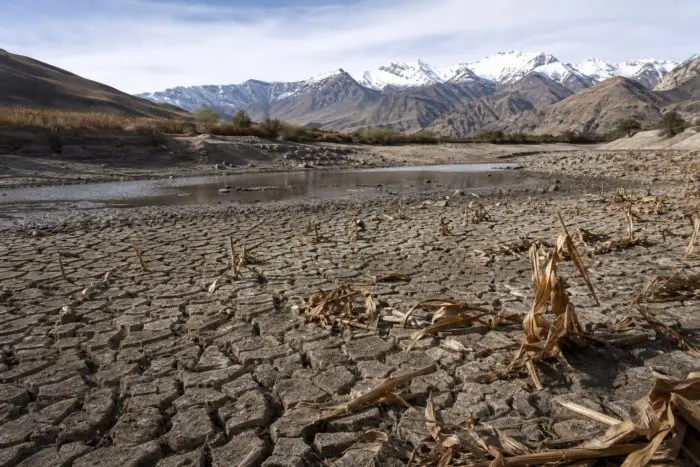
Central Asia is running low on water, and the latest data puts hard numbers on it. Citing World Meteorological Organization figures, the Eurasian Briefing Telegram channel reports that river flows across Tajikistan, Uzbekistan, the Kyrgyz Republic and Afghanistan have fallen well below normal, with the Aral Sea basin among the hardest hit. Recent years rank among the driest since regional record-keeping began in 1991.
The real vulnerability sits up high. More than half of the region's river runoff comes from snow and ice, and glacier melt is accelerating. Central Asia's glacier mass balance is among the three most negative ever recorded. Tajikistan, home to roughly 14,000 glaciers including the vast Fedchenko, has lost over 10% of its glacier cover — about a third of its total glaciated area. The Kyrgyz Republic has more than 8,000 glaciers and has lost over a quarter of its cover; if current trends hold, another third could vanish by 2040.
Downstream, the consequences land hard. Uzbekistan draws over 80% of its water from beyond its borders, so shrinking meltwater feeding the Amu Darya and Syr Darya is a direct national security issue. Turkmenistan relies on the Karakum Canal — fed by the Amu Darya — for over 90% of its water. Kazakhstan's southern farming regions, supplied by the Syr Darya, have already seen repeated drops in inflows to the Shardara Reservoir.
The politics complicate everything. Under the Soviets, one integrated system balanced hydropower needs in the mountains (Kyrgyzstan, Tajikistan) against irrigation demands downstream (Uzbekistan, Kazakhstan, Turkmenistan). That system collapsed with the USSR, and the 1998 Syr Darya water-and-energy agreement no longer matches today's consumption or climate. Analysts suggest a new multilateral deal on the Naryn hydropower cascade or compensation mechanisms for reservoir operations.
Kazakhstan, for its part, is coordinating annual reservoir schedules with its neighbours through the Interstate Commission for Water Coordination and trilateral talks on the Uch-Kurgan hydropower plant and Bakhri-Tojik Reservoir. It is also spending big on infrastructure: plans call for modernising 14,500 kilometres of irrigation canals by 2030 — the country has 8,577 canals totalling around 45,000 kilometres — with the goal of cutting water losses from 50% to 25% and saving over 2.2 billion cubic metres a year.
The outlook is sobering. The Eurasian Development Bank warns of chronic water shortages across the region within five years without major changes, flagging the lower Amu Darya and Syr Darya — Karakalpakstan, Kazakhstan's Kyzylorda Region and parts of Turkmenistan — as most at risk. The UN says salinization and desertification now affect nearly 3 million hectares of irrigated land, up 12% in five years.
For travellers, this is background worth knowing if you're heading to Uzbekistan's Khiva or the shrinking Aral Sea at Moynaq, Turkmenistan's oasis cities or Kazakhstan's southern steppe — water scarcity is reshaping these places in real time, and the landscapes and livelihoods visitors come to see are changing with it.