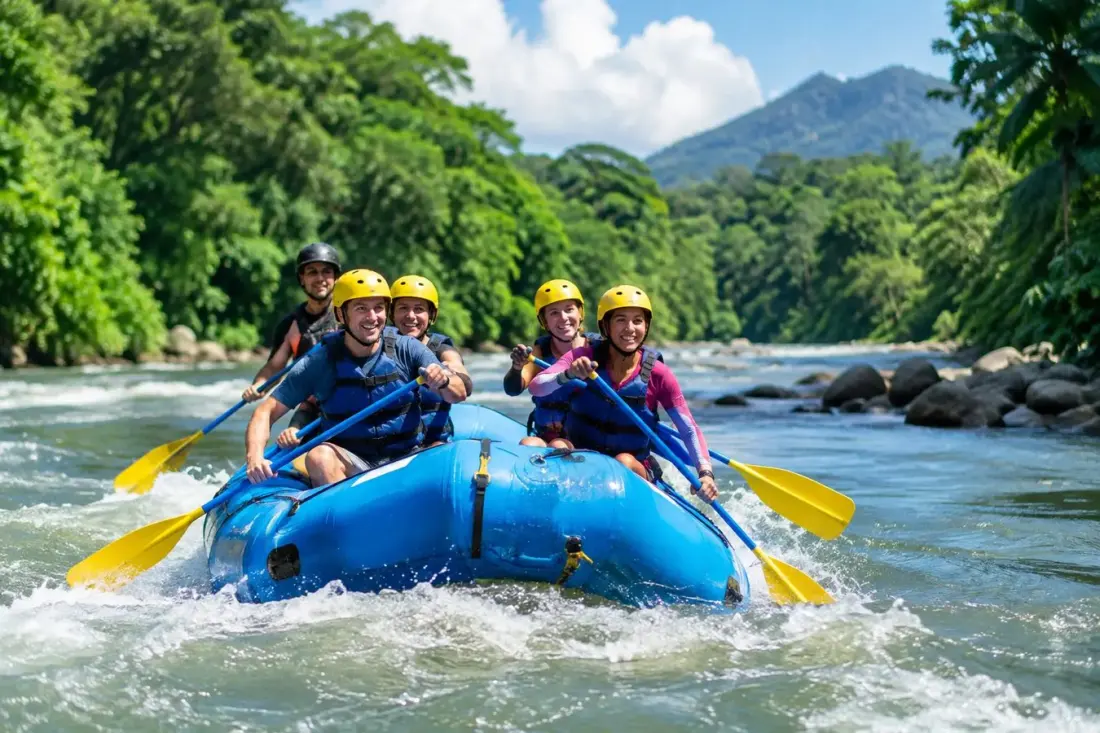
A day on a Costa Rican river starts the same way everywhere: your guide shouts a command, the raft hits its first rapid, and suddenly the rainforest is rushing past in green streaks. But rafting here isn't just a thrill bolted onto a beach holiday. It's one of the best ways to read the country itself — volcanic highlands, coffee country, lowland jungle and the Caribbean slope, all connected by water.
What sets Costa Rica apart is how reachable it all is. You can leave the Central Valley after breakfast and be clipped into a life jacket by lunchtime, on a warm river under toucans and heliconias. No snowmelt chill, no need for veteran paddling skills, and no shortage of guides who know every bend.
**Know your rivers.** The Pacuare is the headliner: Class III-IV rapids through a steep canyon of waterfalls and dense forest, with calm stretches that feel cinematic. Adventurous beginners can manage it if they paddle as a team. The Sarapiquí, near Arenal and La Fortuna, runs gentler Class II-III water suited to families and first-timers, with decent odds of spotting monkeys or iguanas on the banks. The Balsa, also in the Arenal area, is the social pick — enough action to feel earned, enough calm to learn the commands, ideal for mixed groups. On the Pacific side, the Naranjo near Manuel Antonio gets fast and technical in the green season, while the Savegre further south is more scenic and approachable for travellers heading to Dominical or Uvita.
**Timing matters more than you'd think.** Rafting runs year-round, but December through April brings lower water and easier logistics — good for newcomers. May to November means fuller rivers and punchier rapids, which experienced paddlers chase, though heavy weather can shift access points and timing. Microclimates complicate everything, so your guide's assessment that morning beats any calendar rule.
**Vet the operator.** Good companies fit helmets and flotation devices properly, run genuine safety briefings, and employ guides with swift-water rescue and first-aid training. Ask the rapid class for your specific route and date, the minimum age, time on water, and what happens if the weather turns. On the day, learn the paddle commands, practise your fall-out routine, keep feet up if you go in — and leave the flip-flops behind; shoes that stay on matter.
There's a conservation angle too. Rafting depends on clean, flowing water, and Costa Rica's watersheds face real pressures from development, agricultural runoff and shifting rainfall. Choosing operators who employ local guides, limit waste and explain the ecology is a small way tourism supports protection rather than strain.
Who's this for? Pretty much anyone. Families with older kids can pick the Sarapiquí or Balsa; thrill-seekers should aim for the Pacuare or a green-season Naranjo. Build slack into the itinerary — don't book a long transfer straight after your river day, because you'll want time for the post-mortem over a proper Costa Rican meal.