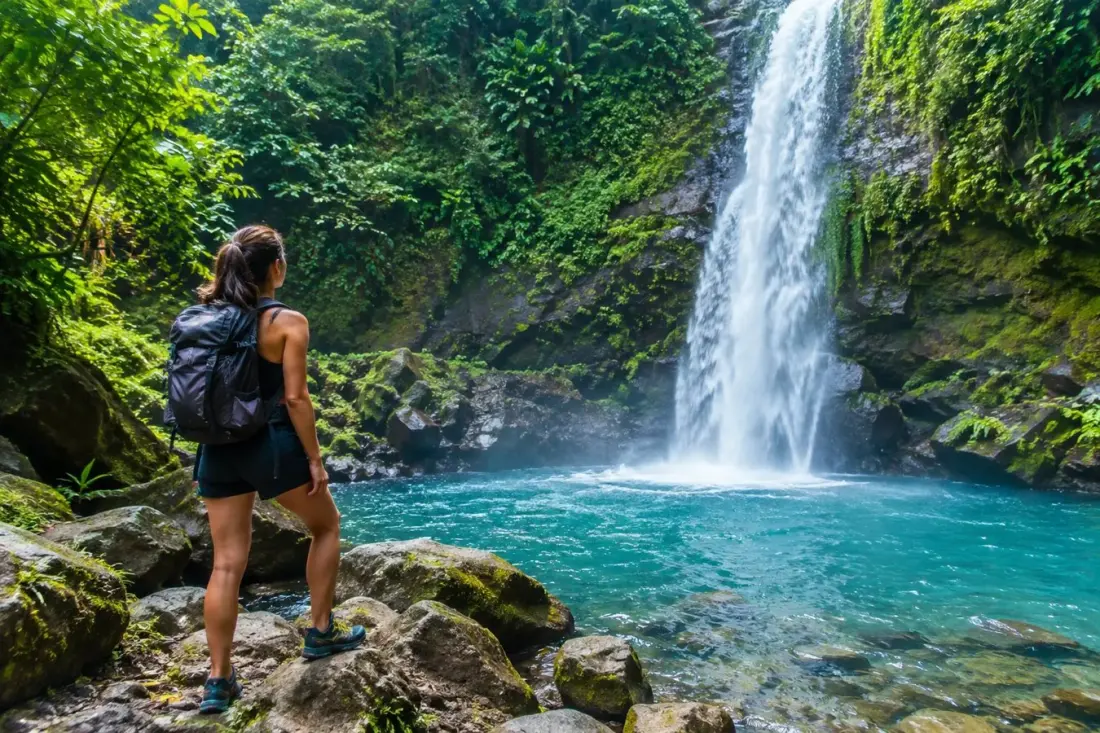
Costa Rica's waterfalls don't just look good from a viewing platform — most of them reward you with a swim, and the fun is in earning it. A new roundup of the country's ten best waterfall hikes sorts them by effort and reward, and the range is wider than most first-timers expect: 500-step staircases, suspension-bridge crossings, natural rock slides, and one short stroll that ends at a sandy-edged swimming pool.
The classic is La Fortuna near Arenal Volcano, a 230-foot curtain of water reached down roughly 500 well-kept steps — the climb back up is the real workout. Nearby in spirit but not in colour is Río Celeste in Tenorio Volcano National Park, where a natural mineral reaction turns the river an almost artificial blue. Swimming is banned here; the river's chemistry is protected, so it's strictly a look-don't-dip stop.
For a proper half-day, Nauyaca near Dominical on the South Pacific delivers twin cascades into broad swimming pools, with a hot, rolling trail (or a partial shuttle if you'd rather save your legs). In the other direction, Guanacaste's Llanos de Cortés near Bagaces flips the script on the dry province: a short walk to a wide fan-shaped fall with calm water and sandy edges — the pick for families.
The cloud-forest valley of Bajos del Toro packs in two of the wildest options. Catarata del Toro plunges into an extinct volcanic crater, while the nearby Blue Falls crosses private reserve land on steeper, rootier trails to a chain of blue pools — best after dry weather, since heavy rain can turn the water brown.
Easier add-ons include Los Chorros near Grecia (two falls, short trail, easy pairing with the craft town of Sarchí) and Uvita's playful rock slide on the Costa Ballena. Rincón de la Vieja National Park offers two very different days: the Oropéndola Waterfall, reached via a canyon suspension bridge and best combined with the area's hot springs, and La Cangreja, the longest and toughest of the ten — a real heat-and-distance hike to a pale-blue pool that needs an early start and more water than you think.
Timing matters more than most travellers realise. The green season (roughly May to November) gives the falls their fullest force and the forest its lushest look, but brings mud, afternoon rain and occasional closures. The dry season is easier travelling, though smaller falls can underwhelm. Either way, mornings are the sweet spot — quieter trails, softer light, and fewer crowds at the swimming holes.
Kit is simple: closed-toe shoes with grip rather than flip-flops, a dry bag, insect repellent, reusable water and a change of clothes. Skip the rock-jumping unless staff on site confirm the pool is safe, since depths and currents shift with rainfall. And the etiquette that keeps these places wild: stay on marked paths, leave the soap and lotion ashore before swimming, and pay the entrance fees — many of these falls survive because local families and landowners chose protection.
If you only have a few days, La Fortuna and Llanos de Cortés are the convenient picks; Río Celeste and Catarata del Toro give maximum drama; Nauyaca and Blue Falls suit anyone who wants to work for the swim.