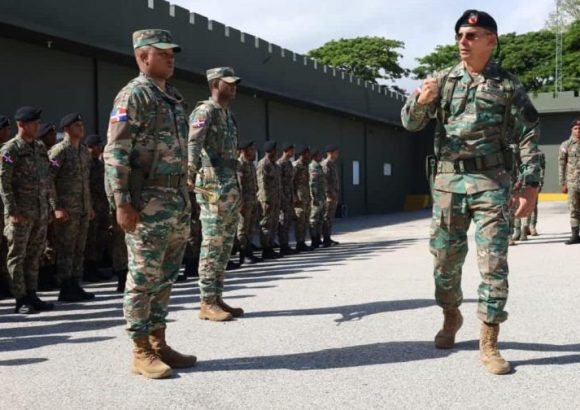
The Dominican Republic has stationed more than 10,000 military personnel along its roughly 300-kilometre land border with Haiti, in one of the largest security deployments on the island in recent memory. Fresh convoys were reported arriving in Jimaní, the southern border town, where around 40 soldiers entered a military facility by tank and truck, with at least seven Army vehicles seen in the area.
José Ignacio Paliza, the Minister of the Presidency, said the deployment is meant to secure the entire border line, and confirmed that around 80 kilometres of border wall should be finished by the end of 2027. He also stressed that, despite the chaos across the frontier, the Dominican Republic has recorded no incidents affecting its own security since the Haitian crisis began.
The situation on the Haitian side remains grim. A Salvadoran contingent landed in Port-au-Prince to help search for four soldiers from the multinational security force who vanished after an ambush near the capital. Salvadoran president Nayib Bukele, whose country leads the mission, described Haiti's gangs as "satanic" and vowed victory. The force, authorised by the UN Security Council a year ago to fight the armed groups, currently has about 1,000 personnel of a planned 5,500, and its mandate was renewed for six months on 29 September.
The human toll is severe: the UN blames gang violence for more than 5,700 people killed or injured in Haiti this year alone, plus over 230 kidnappings and the rape of more than 1,000 women and girls. Against that backdrop, the presidential and legislative elections set for 13 December are in doubt — the Provisional Electoral Council has postponed the campaign launch and promised a new calendar that has yet to appear.
So why should holidaymakers care? For now, the Dominican Republic — which welcomes millions of visitors a year to Punta Cana, Santo Domingo and Puerto Plata — remains untouched by the unrest, and its tourism zones sit far from the Haitian frontier. The main practical takeaway is to avoid overland crossings into Haiti, including the popular cross-border day trips from Jimaní or Dajabón, until the situation stabilises. Travellers with trips booked in the DR can carry on as normal, though it's worth keeping an eye on official advisories. Anyone considering Haiti itself should not travel there under current conditions: the capital is effectively controlled in large part by armed groups, elections are uncertain, and foreign governments advise against all travel.
In short, this is a story about an island drawing a hard line. The Dominican side is fortifying and staying open for business; the Haitian side remains off-limits for the foreseeable future.