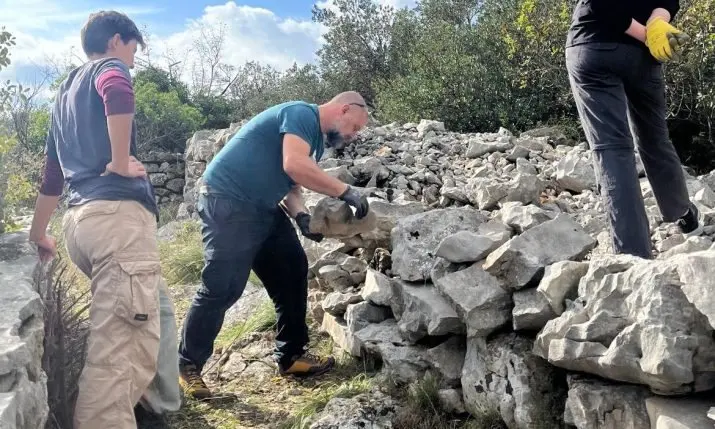
A small international crew is spending four weeks in Dalmatia doing something unusually hands-on for a holiday destination: rebuilding centuries-old stone walls, one carefully placed rock at a time.
The project, called Solidarity for Natural Heritage, kicked off on 4 November 2026 at Vransko Lake Nature Park and is now in its fifth year. Six young volunteers from Finland, France, Ireland, Portugal and Austria are working 29 days on conservation tasks around the park. Their duties go beyond the famous dry stone walls of the Modrave area — they're also maintaining visitor infrastructure and restoring a floodplain meadow.
Dry stone walling might sound niche, but it's a UNESCO-recognised craft. The technique involves stacking stones so precisely that no mortar is needed, and it has shaped Croatian landscapes for generations. Along the coast and on the islands especially, these walls once marked property boundaries, shielded crops from wind and made farming possible on stubborn rocky ground. Today they're as much a part of the scenery as the sea itself.
The volunteering scheme runs under the European Solidarity Corps, the EU programme that funds community projects across the continent. For participants, it's a chance to learn a traditional building skill from people who still practise it; for the park, it's free labour with real conservation value. There's a broader point too: the project treats nature and culture as two sides of the same coin. A wall built without mortar drains water differently, shelters wildlife and keeps rural areas looking like themselves — so restoring one is both an ecological and a heritage act.
Why should a regular traveller care? Vransko Lake is Croatia's largest lake, sitting just inland from the BIograd and Pakoštane coast, and it remains one of the country's quieter nature parks. The dry stone walls you pass on a walk or cycle ride around the lake aren't decorative quirks — they're the result of exactly this kind of skilled work, increasingly carried out by young Europeans on working holidays. If your idea of a good trip involves getting your hands dirty rather than lying by a pool, schemes like this one show that volunteering and travel increasingly overlap. And even for casual visitors, knowing the story behind those stones adds a layer to an afternoon in the park.
The bottom line: Croatia's postcard landscapes don't maintain themselves, and this fifth edition of the project shows a model that keeps both the habitat and the heritage craft alive.