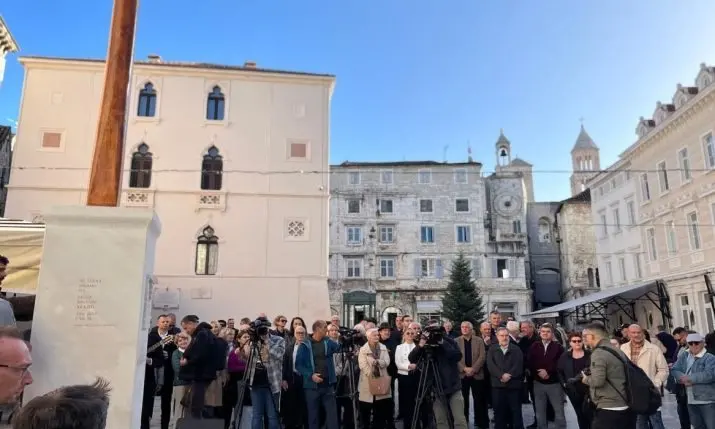
Split's main square has its landmark back. The Štandarac, the traditional stone monument and flagpole at the heart of Narodni trg — known locally as Pjaca — has been reinstated after more than a year away, following a legal fight that turned a piece of civic furniture into one of Croatia's most argued-over monuments.
The official return came with proper ceremony: Mayor Tomislav Šuta and the monument's creator, sculptor Kuzma Kovačić, presided as the City of Split flag was raised to the sound of classic Dalmatian klapa songs, including Marjane, Marjane and Splite moj, performed by klapa Šušur in front of a big crowd.
The backstory is tangled. In 2023, under then-Mayor Ivica Puljak, the city added an inscription marking 26 October 1944 — the date Split was liberated from fascism — at the request of anti-fascist associations. Kovačić objected that the text had been added without his consent and breached his artistic copyright. The Commercial Court agreed and ordered the inscription removed. Rather than just take off the text, the city removed the entire monument in February 2025 and proposed replacing it with a new one — a move that triggered protests and pulled the dispute into broader political arguments about how Split's wartime history should be commemorated.
The saga ended via a Commercial Court interim measure from July, after the City Council revoked the acts blocking reinstatement. Split firm NEIR carried out the restoration and reinstallation, with the total bill coming to €79,938.75 including VAT. The monument is back in Kovačić's original form, with a new flagpole, and the contested liberation date is still commemorated nearby on the square — just no longer on the monument itself.
Why should a traveller care? Pjaca is the square most visitors to Split end up crossing daily — it sits between the Riva waterfront and the old town, ringed by cafés and framed by the medieval Mletačka vrata gate. The Štandarac, a stone monument tied to the raising of the city flag, is part of that square's historic character, so its return restores a familiar photo stop. It's also a nice example of how layered and contested Dalmatian history remains — the square itself is a working monument to it.