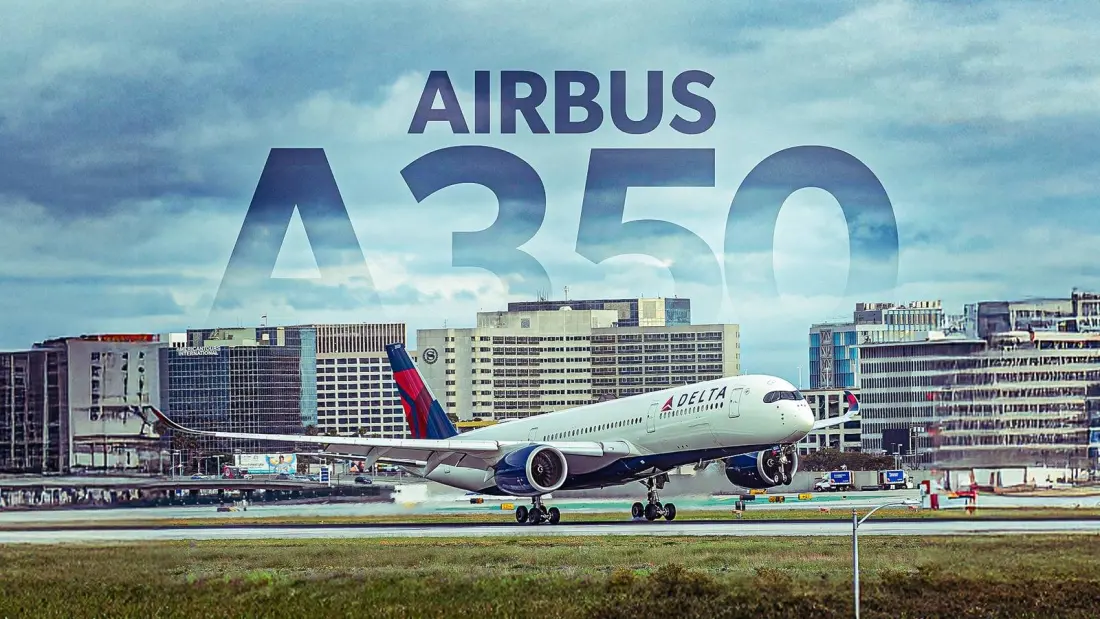
Before it could carry passengers nonstop from Singapore to New York, the Airbus A350 had to earn its stripes in some deeply unglamorous places: a frozen airfield in northern Canada, a desert airport in the UAE, and the world's highest international airport in Bolivia.
Airbus ran its A350-900 certification campaign in just over 14 months — an industry record at the time — with five test aircraft logging more than 2,600 flight hours before EASA and FAA type certification in 2014. But the headline numbers only tell part of the story. The real proof came from environmental trials designed to push the aircraft well beyond anything a normal airline day throws at it.
Cold came first. In January 2014, the A350-900 test aircraft sat through a deep freeze in Iqaluit, Canada, at temperatures down to -28°C, where a 48-person Airbus team checked cold-soaked engine and APU starts, taxi trials, rejected takeoffs and a local test flight. The larger A350-1000 returned in 2017 for five days of testing in conditions between -28°C and -37°C. Airbus also became the first manufacturer to put one of its aircraft through the McKinley Climatic Laboratory in Florida, a giant hangar that can simulate anything from -40°C to +40°C on demand.
Heat was the next hurdle. In July 2017, the A350-1000 spent three days at Al Ain in the UAE, where temperatures peaked at 48°C. Engineers wanted to know whether the Rolls-Royce Trent XWB engines and the air-conditioning systems could cope — not just in the air, but on the ground, where keeping a cabin cool is hardest. The timing was pointed: weeks earlier, extreme heat in Phoenix, Arizona, had grounded dozens of flights by regional jets with lower temperature limits. The A350-1000 passed all its Al Ain parameters.
Then the thin air. At El Alto International in La Paz, Bolivia — around 4,061 metres above sea level, where air density is roughly 40% lower than at sea level — both A350 variants were tested on engine starting, thrust response and takeoff performance. Airbus' head of design development flight tests, Jean-Philippe Cottet, flagged high-altitude engine starts as a key reason for the Bolivia trips.
All of this matters because the A350 has become the aircraft of choice for ultra-long-haul flying. Beyond certification, Airbus ran a route-proving tour of 14 airports and an Early Long Flights program with employees as passengers. The result: Singapore Airlines' A350-900ULR flights to New York exceeding 18 hours, and Qantas' Project Sunrise, which will use a modified A350-1000ULR with an extra 20,000-litre fuel tank for nonstop Sydney–London and Sydney–New York services. Qantas has even worked with the University of Sydney's Charles Perkins Centre on 20-hour trial flights, testing lighting, meal timing and movement routines that reduced reported jet lag among volunteers, and plans a dedicated Wellbeing Zone on board.
For travellers, this is the quiet engineering behind the flights that shrink the planet — the reason a 19-hour nonstop in a cooler, more humid, lower-altitude cabin is now a bookable reality rather than a science experiment.