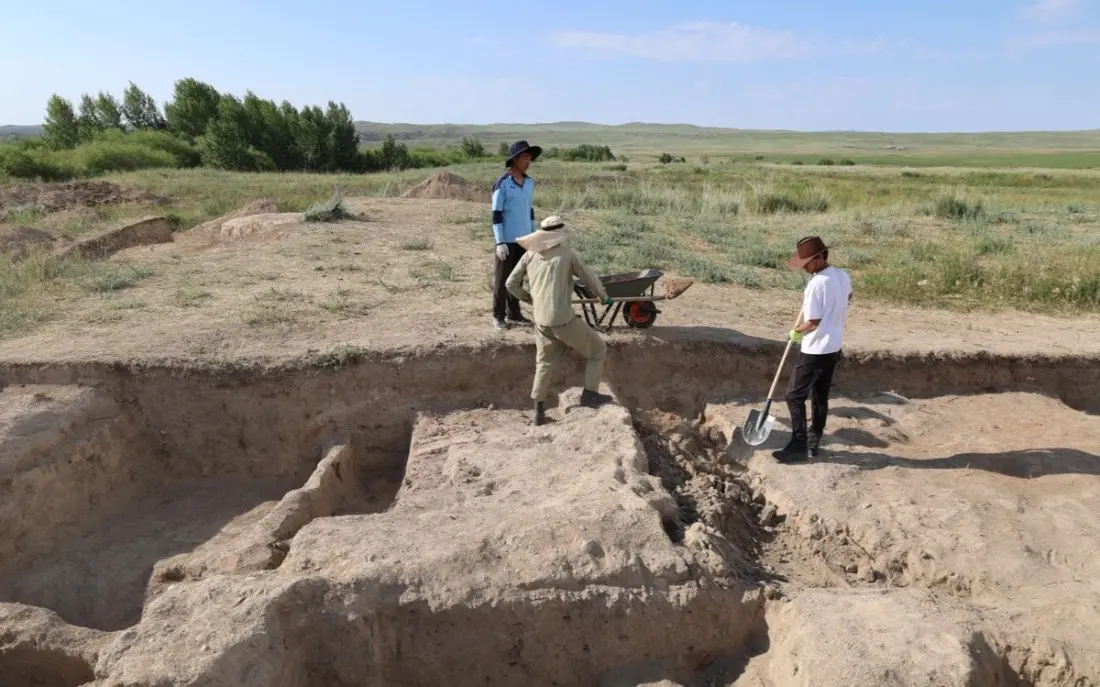
A Texas-born archaeologist who has spent three decades in Kazakhstan is putting a little-known Silk Road city on the map. Steven Gilbert leads excavations at Ilibalyk, a medieval trading town in the Ili River valley near the Chinese border, where his team has uncovered the first clearly documented Christian cemetery in Kazakhstan from before the Russian Empire era.
Ilibalyk appears in Armenian, Persian and Chinese sources from the 12th to 14th centuries as a stop on the route to Almaliq, capital of the Chagatai rulers. The site sprawls across roughly five square kilometres and had never been excavated before digs began in 2016 — a joint effort between the Lanier Center for Archaeology in the US and Kazakh specialists, now run with Almaty-based firm Rutrum and partners including the Swiss Society for the Exploration of Eurasia.
What they've found is striking. More than 50 gravestones, called kairaks, carry cross images; six bear epitaphs, four in Old Turkic and two in Syriac, the liturgical language of the Church of the East. Names like Petros, Isho, Shirin and Tegiz point to a Turkic-speaking Christian community that thrived here for nearly two centuries alongside Muslims, Buddhists, Manichaeans and followers of Tengrism. Nearby, the team uncovered the foundations of a 23-by-eight-metre funerary chapel — the first structure of its kind ever found. At least five women were buried wearing boqtaq headdresses reserved for high-status married women, possibly from the kereit or naiman tribes linked to Mongol royalty. Pearls and coral among the finds hint at residents wealthy enough to buy goods hauled in by caravan.
Life wasn't easy, though. Signs of malnutrition show up in almost every burial, children were buried nearly as often as adults, and few reached old age — evidence Gilbert ties to brutal winters and the civil wars between the Chagatai and Yuan uluses.
Gilbert's own story is part of the appeal. He arrived in 1993, just after independence, doing humanitarian work and teaching English, and learned Kazakh from day one — a video of him speaking it fluently went viral this summer. A one-metre Christian gravestone found by a schoolteacher near Usharal in 2014 pulled him into archaeology; he's now associate director of the Tandy Institute in Texas and splits his year between the two countries. This season's team hit nearly 40 people, with volunteers from South Korea, Australia, the UK, Singapore and beyond.
For travellers, this is a rare chance to watch history being rewritten in real time. Most Kazakhs themselves didn't know Christians lived on their soil nearly a thousand years ago, and Gilbert hopes local museums in the Panfilov District will eventually display the gravestones. The site is state-protected, all artefacts stay in Kazakhstan, and locals have started reporting illegal treasure hunters. If you're driving the Zhetisu region or crossing toward the Dzungarian Gate, Ilibalyk offers something few Silk Road stops can: an unfinished story you can see emerging from the steppe.