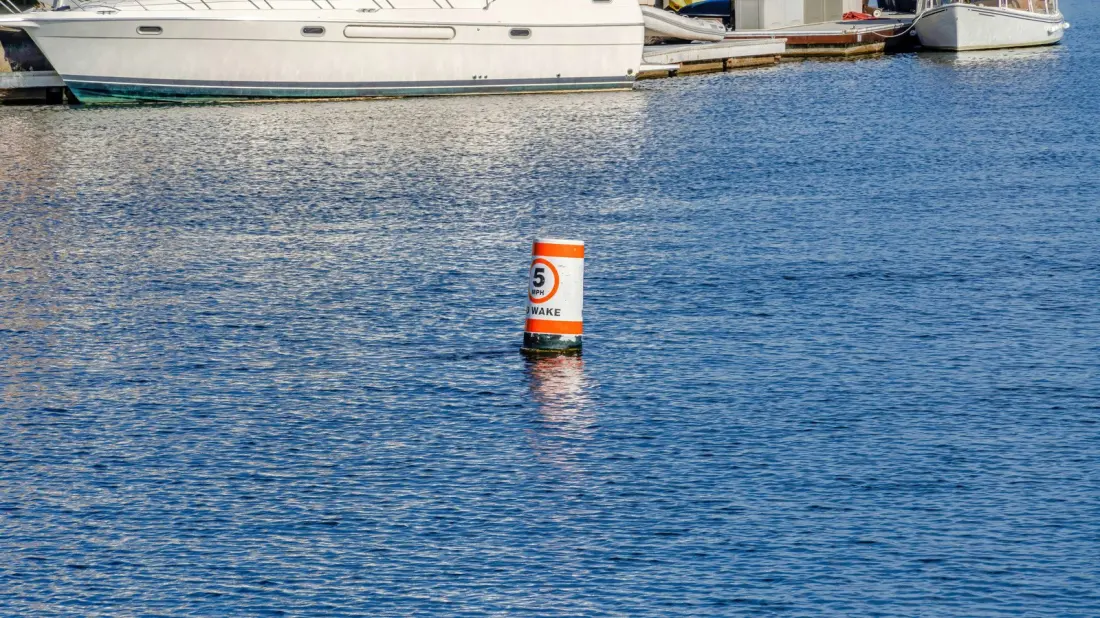
Spotting a white cylinder topped with orange bands floating on a lake might not seem like a big deal, but that buoy is talking to you. If it carries an orange circle, you're entering a regulated area, and the rules for how fast you can go are spelled out right there in black text.
Regulatory buoys like these are common across the United States — on the Great Lakes, smaller inland lakes, rivers, and even some coastal waters. The design follows a simple formula: a white body with an orange band near the top and another near the waterline, with the orange circle centred in the middle. In choppier spots, the buoy may have a wider base or float collar to keep it upright.
Here's the thing: the shape does the heavy lifting, but the words do the detail work. A circle means controlled or restricted operation, and the most common messages are speed limits, no wake, or idle speed — all designed to protect shorelines, docks, and swimmers from damaging wakes. A square means information, a diamond warns of a hazard, and a diamond with a cross inside means no entry for boats or swimmers. Get the shapes wrong and you could steam into danger or break a local rule.
If you're new to boating, the practical response is straightforward. Slow down as you approach so you can actually read the text. If it says no wake or idle speed and you don't have a way to measure your speed, go as slowly as you can while still making forward progress and keeping steerage. That's the safest interpretation, and it's what wardens expect to see.
Why should a holidaymaker care? Renting a boat is one of the best ways to enjoy America's lakes, whether you're planning a day on Lake Michigan, a cabin trip in the Midwest, or a summer on a smaller inland lake. But rental operators and local authorities do enforce buoy rules, and damaging wakes near docks or swimmers can mean fines or a ruined day. Knowing your orange shapes takes five minutes and makes you look like you know what you're doing at the helm.
The same logic applies to mooring buoys and channel markers — learn the basic colour and shape codes once and you'll be able to read almost any waterway you visit. For travellers heading stateside with boating plans, it's worth a quick refresher on US aids to navigation before your first outing, especially since the messages on these buoys can vary substantially from one lake to the next.
Bottom line: white buoy, orange circle, read the text, slow down. Simple, and it keeps the water safer for everyone — including the swimmers you can't always see.