
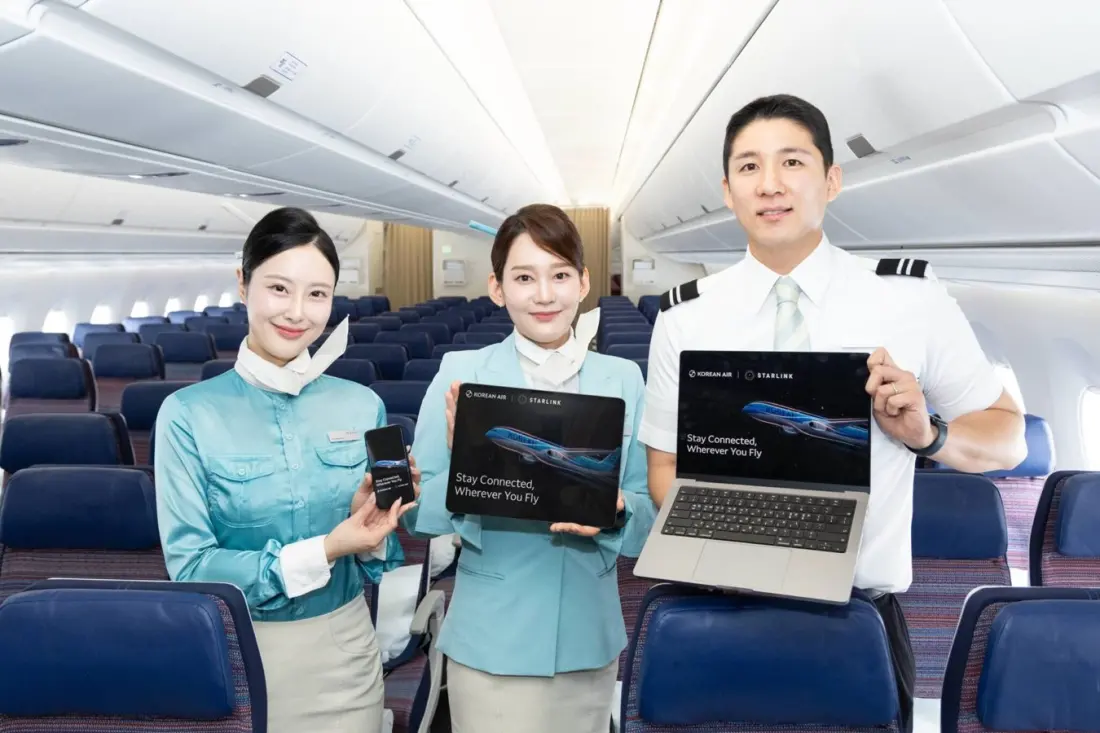
Korean Air has switched on free Starlink Wi-Fi aboard its first four aircraft, and the airline is pairing the fast new connectivity with an unusually firm rulebook: no voice calls, no video calls, and no livestreaming from your seat.
The initial rollout covers three Airbus A350-900s and one Boeing 777-300ER, which mostly fly medium- and long-haul routes to North America, Europe and Southeast Asia, though they can also turn up on shorter sectors. That is a small slice of the fleet, but Korean Air has committed to fitting Starlink on most of its aircraft by the end of 2027 — making it, according to the airline, the first major East Asian full-service carrier to deploy the satellite service.
Access is genuinely free across every cabin. There is no SkyPass membership requirement; you simply join the onboard network, enter your name and seat number as printed on your boarding pass, and sit through one advertisement. Once connected, the airline says the link is strong enough for streaming video and music, messaging apps, online gaming, general browsing and cloud-based work platforms — a serious upgrade over the paid, often sluggish conventional Wi-Fi Korean Air offered on selected aircraft before.
The restrictions are the interesting part. Starlink could easily support Zoom calls or an Instagram live broadcast at 35,000 feet, and Korean Air has decided to block both. The stated reasoning is cabin comfort and aviation security, but there is an obvious practical logic too. Anyone who has sat near a passenger blasting videos or taking calls on a flight with fast internet will recognise the problem: capability has outpaced courtesy, and cabin crew are rarely in a position to police it. By removing calls outright, Korean Air eliminates the grey area and makes enforcement straightforward. Passengers can still work, message and stream — just not turn row 34 into a conference room.
For travellers, this is one of the more appealing in-flight connectivity stories of the moment. Free, streaming-quality internet on long-haul flights to and from Asia is a real money-and-hassle saver, whether you want to keep working, entertain kids on a transpacific leg or simply message home from the air. The catch for now is aircraft roulette: only four planes have it, so you may not get Starlink even on a route it serves. The rollout through 2027 is what makes this meaningful rather than a one-off PR exercise.
It is also worth noting the tone this sets. Other airlines offering Starlink have taken a lighter-touch approach to what passengers do with it, and the results are not always pleasant. Korean Air's decision to build etiquette into the technology from day one may prove the smarter template — fast Wi-Fi without the seatmate livestream. If you are booking Korean Air long-haul in the next year or so, it is worth checking whether your flight is on an A350-900 or 777-300ER; if it is, you might just be among the first to try it.
Story via Live and Let's Fly