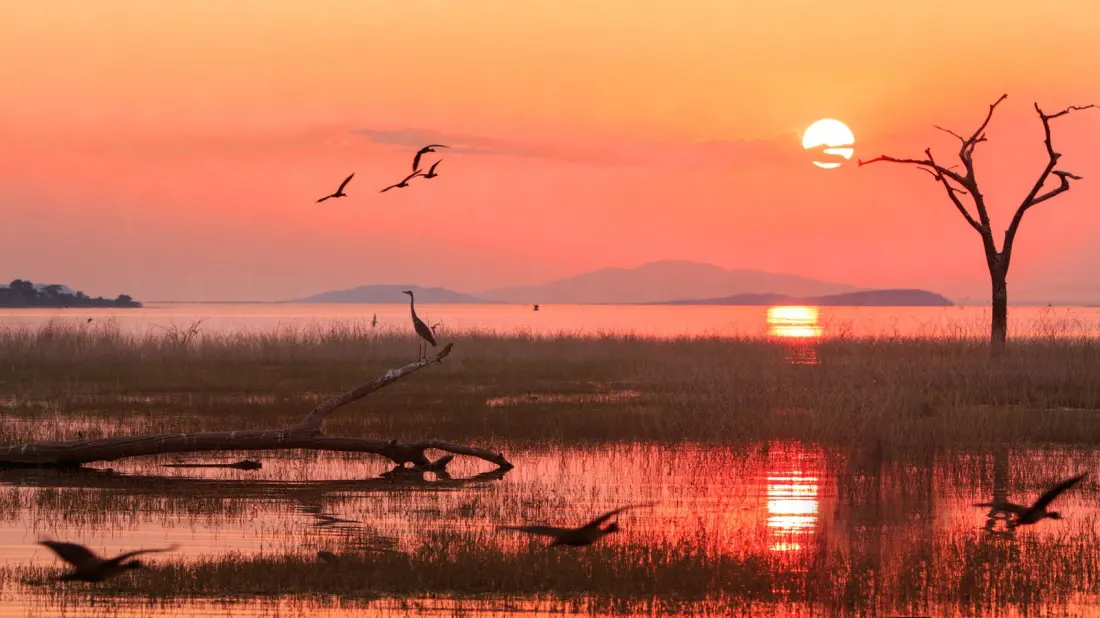
Downstream from Victoria Falls, along the Zambezi River, sits a giant most travellers have never heard of. Lake Kariba, straddling the Zimbabwe-Zambia border, is the largest artificial lake on Earth by volume, holding 44 cubic miles of water across more than 2,100 square miles. The Kariba Dam, completed in the late 1950s, created this reservoir to generate hydroelectric power for both countries — and accidentally created one of Africa's most atmospheric safari settings.
The lake's signature look comes from the skeletal dead trees rising out of the water, leftovers of the forest flooded when the dam closed. Against sunset skies, they make for some of the most photogenic waterscapes on the continent.
The wildlife draw is Matusadona National Park, a 540-square-mile reserve on the southern Zimbabwean shore, backed by hills over 2,000 feet high. Elephants here are known to swim in the lake, and the park hosts hippos, zebras, buffalo, antelope, lions, leopards and — as of recently returned populations — endangered black rhino. Birders have nearly 400 species to chase, including the African fish eagle and lilac-breasted roller. You can explore by self-drive or guided game drives, on walking safaris, or by boat.
Where to stay: Tashinga Campsite offers tented lakeshore camping with kitchens and bathroom facilities, while Rhino Safari Camp has seven thatched chalets overlooking the water, game drives, boat cruises and sundowners. Its 4.9-star Tripadvisor rating comes with reports of lions, elephants, hippos, kudu and crocodiles spotted from camp.
Anglers have their own reasons to come. The lake holds more than 40 fish species, but the star is the tigerfish — fast, toothy and famously aggressive, with a Kariba record of around 35 pounds. September to December is prime tigerfish season, and October brings the Kariba International Tiger Fish Tournament, a multi-day catch-and-release competition running since 1962. Fothergill, a lodge on an island inside Matusadona, runs guided catch-and-release trips for all skill levels, targeting tigerfish, bream, tilapia, catfish and the giant vundu.
Getting there is part of the adventure: fly into Kariba Airport (KAB) by charter, or drive about five hours from Victoria Falls, which pairs perfectly as a before-or-after stop. With Zimbabwe shaping up as an underrated pick for 2026, Kariba offers a quieter, water-based alternative to the classic safari circuit — big game, big fish and big skies without the crowds.