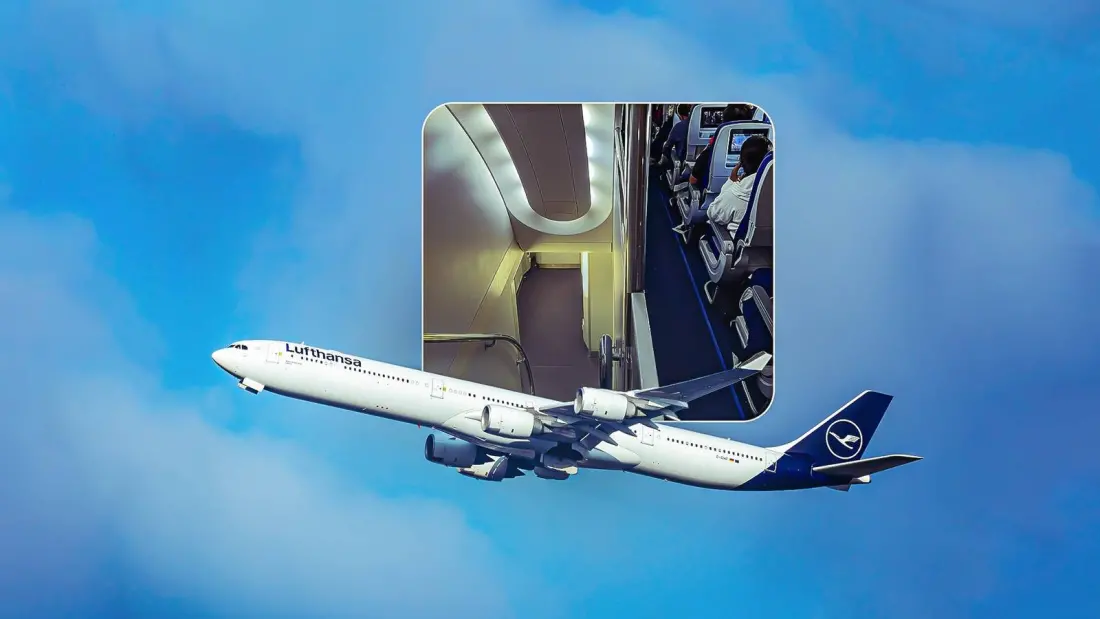
Lufthansa is retiring its Airbus A340-600s from passenger service this weekend, and with them goes one of commercial aviation's oddest features: toilets located below the passenger deck, down a staircase in what is technically the cargo hold.
The A340-600 is a huge aircraft, roughly 75 metres long, and Lufthansa was its biggest operator. In the early 2000s, the airline used the jet's unusually tall, roomy underfloor hold to install a small lavatory complex on the lower deck, reached via a compact staircase near the mid-cabin galley. The bathrooms are fully pressurised, temperature-controlled and certified like any other onboard facility — passengers who have used them describe a quiet, surprisingly private and spacious experience.
Why bother? Space on the main deck was the driving factor. Moving some toilets downstairs freed room for extra seats, larger galleys and less congestion in business class, and it cut down queues in the aisles during meal service. A waiting area downstairs could hold up to ten people. Weight distribution on very long flights also improved, and passengers reported none of the usual toilet smells lingering at the rear of the cabin. Lufthansa kept some main-deck lavatories for passengers with reduced mobility, since the stairs were an obvious accessibility issue.
The feature was unique to Lufthansa — no other A340 operator copied it — but the idea wasn't entirely unprecedented. Some Thomas Cook Airbus A330-200s in the late 1990s and 2000s had similar lower-deck lavatories, and the Soviet Ilyushin Il-86 went further still, with an entire lower-deck galley and internal stairs. Double-deck jets like the 747 and A380 use lower-deck elevators to move galley carts, but they never needed to repurpose cargo space because they had a second passenger deck to work with.
The design never spread because it added operational complexity without enough payoff on aircraft with smaller holds. Crew had to monitor facilities outside the main cabin, and access to the stairs could be restricted during turbulence. For anyone flying one of the final A340-600 services, the oddity is simply a matter of following the signage and crew guidance — and enjoying a genuinely memorable slice of aviation history before the type disappears from scheduled passenger flying.