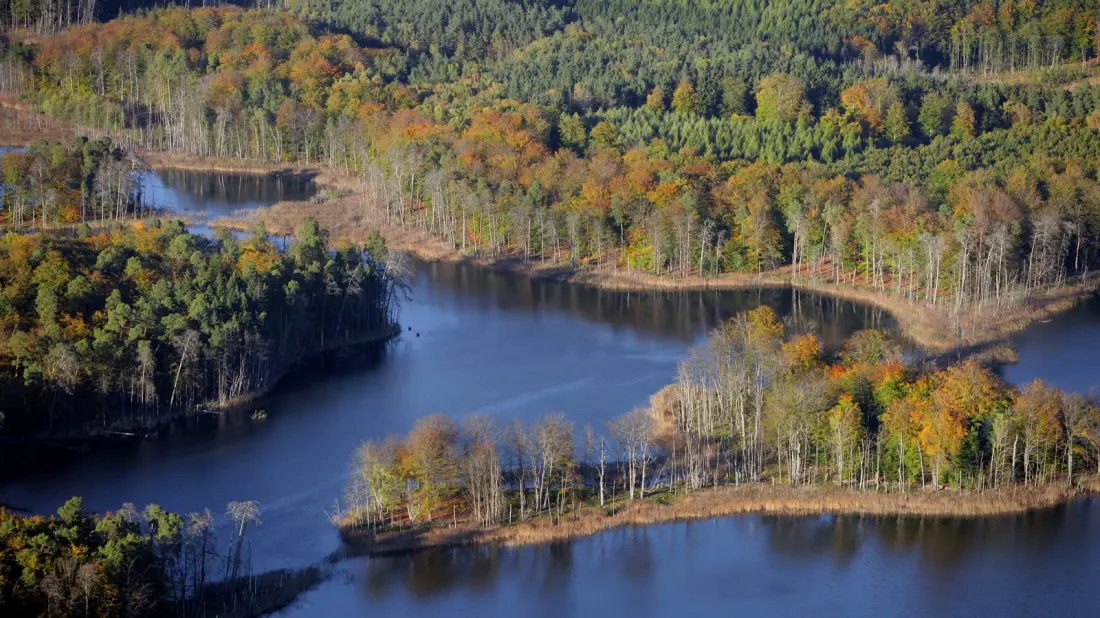
Two hours north of Berlin, the Müritz National Park protects 124 square miles of pine and ancient beech forest in Mecklenburg's lake country — the largest forested national park in Germany, holding over 100 lakes inside its borders. The park is named for Lake Müritz and sits in the Mecklenburg Lake District, a region so waterlogged it's known as the 'Land of a Thousand Lakes.' German national parks follow a hands-off philosophy of letting nature manage itself, which means what you walk through here is genuinely wild.
The park splits into two halves. The western Müritz tract is the lake-and-trail zone: a network of 410 miles of paths, plus canoe routes across the lakes. Birders come for ospreys, white-tailed eagles and cranes; hikers may cross paths with red deer. The eastern Serrahn tract is the quieter prize — a beech forest that has grown largely undisturbed since the Middle Ages and now carries UNESCO World Heritage status as part of Europe's primeval beech forests, remnants of woodland that once blanketed 40% of the continent.
Practicalities are simple. Waren's National Park Service centre is a good first stop for maps and tours, and there's another information point in the hamlet of Kratzeburg (Dorfstrasse 31), open daily 10 a.m. to 5 p.m. from May to October. Paddlers can rent canoes from Kanu-Hecht in Kratzeburg and follow the Havel River route 14 miles south, or take a shorter two-mile paddle via the Bolter Kanal and camp at the Bolter Ufer (C15) campground on Lake Müritz. Neustrelitz is the handy rail-and-road hub: about 30 minutes away on the B198.
For the Serrahn side, park at Zinow and walk or cycle the roughly two-mile trail southeast to the village of Serrahn — cars aren't allowed. En route you pass an observation point, a boardwalk and the site of an old Slavic settlement. The visitor centre there has a UNESCO exhibit on Europe's primeval beech forests and a café for a warm-up drink. Keen walkers can pick from nine routes on the 103-mile Müritz National Park Trail, which ranges from lakeside strolls to forest hikes under hunting ospreys.
Who is this for? Anyone who wants a low-key, water-and-forest escape without alpine crowds — families with canoes, birdwatchers, and hikers who like their trails flat and their scenery green. It also pairs naturally with a Berlin city break, and if you're collecting UNESCO beech forests, Jasmund National Park on the Baltic coast with its famous chalk cliffs is within reach for a second stop. Overnight options lean rustic: the family-run Campinghof Am Grünen Baum southeast of Neustrelitz (open April to October, rated 4.9 on Google) keeps you right at the forest's edge. Come between May and October for full visitor services and open canoe rentals; spring and early autumn bring cranes and fewer people.