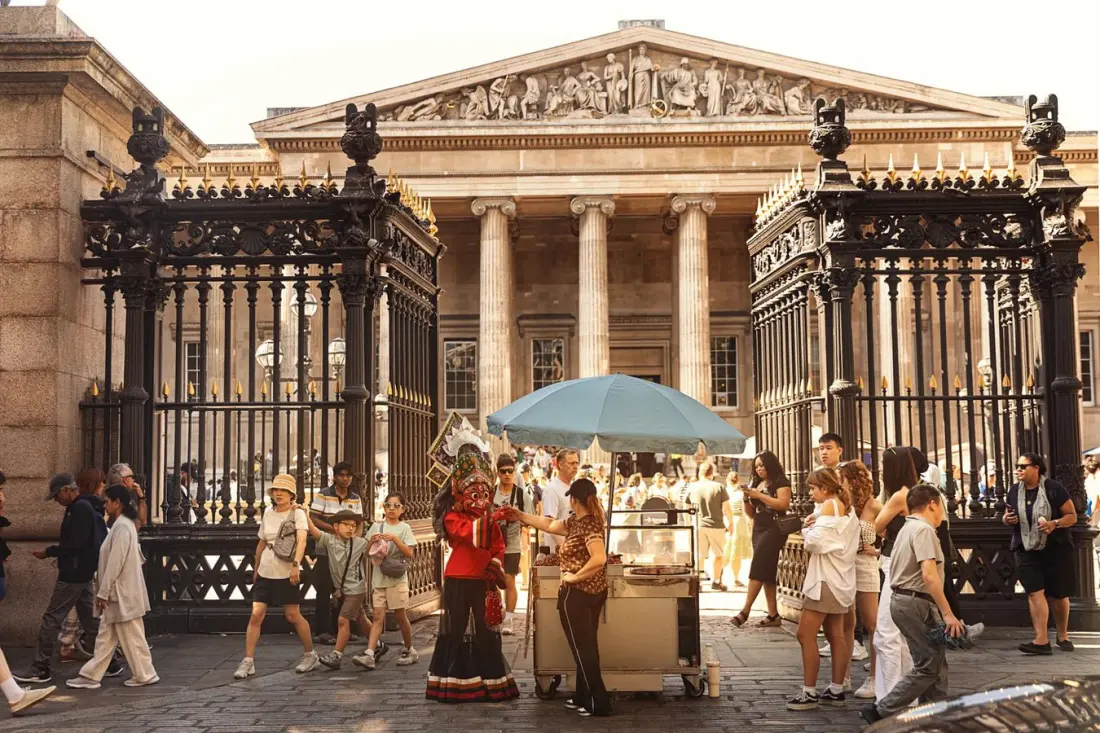
A masked god waits at a London bus stop. Cyclists ride past. Nobody looks twice. That's the central image of The Unwilling Travellers, a photo project by 27-year-old Nepali photographer Aayush Shrestha, which reimagines sacred sculptures taken from the Kathmandu Valley over the past century as reluctant migrants still finding their feet in the West.
Shrestha, a fine arts graduate of Kathmandu University who moved to London for a master's in digital photography at Ravensbourne University, came up with the idea after visiting the British Museum and the Victoria and Albert Museum. Seeing Nepali deities behind glass disturbed him. Humans migrate with purpose, he reasons, but these gods were taken against their will — and they are, in his words, still waiting to go home.
The book doesn't try to litigate the history of how Nepal's living gods ended up as 'art' in Western museums and private collections. Instead it works on a fiction: after decades abroad, the gods became travellers themselves. Masked and ornamented figures drift through everyday London — waiting for buses, cycling down streets, sitting alone in parks. Shrestha deliberately used London's cityscapes as the opposite of where the gods belong, wanting them to look a bit lost yet trying to cope.
There's real ritual weight behind the concept. In Nepali tradition, a mask consecrated for performance is understood to hold divine presence, not merely depict it. That's why museum display troubles Shrestha: once an object is catalogued with an inventory number, it may be kept carefully, but its original meaning and purpose is not preserved. He stops short of calling the project activism — though he admits it inevitably feeds into the political debate around restitution and repatriation of stolen heritage.
Shrestha's graduation exhibition ran at Photobook Cafe in London from 11 to 13 September, and he plans to publish the book in Nepal soon. For travellers, it's a thought-provoking lens on a question you'll bump into in almost any major Western museum: how sacred objects from living traditions ended up as exhibits, and what it would mean for them to return. It might also sharpen a trip to Kathmandu itself, where these gods still have homes, festivals and communities waiting for them.