
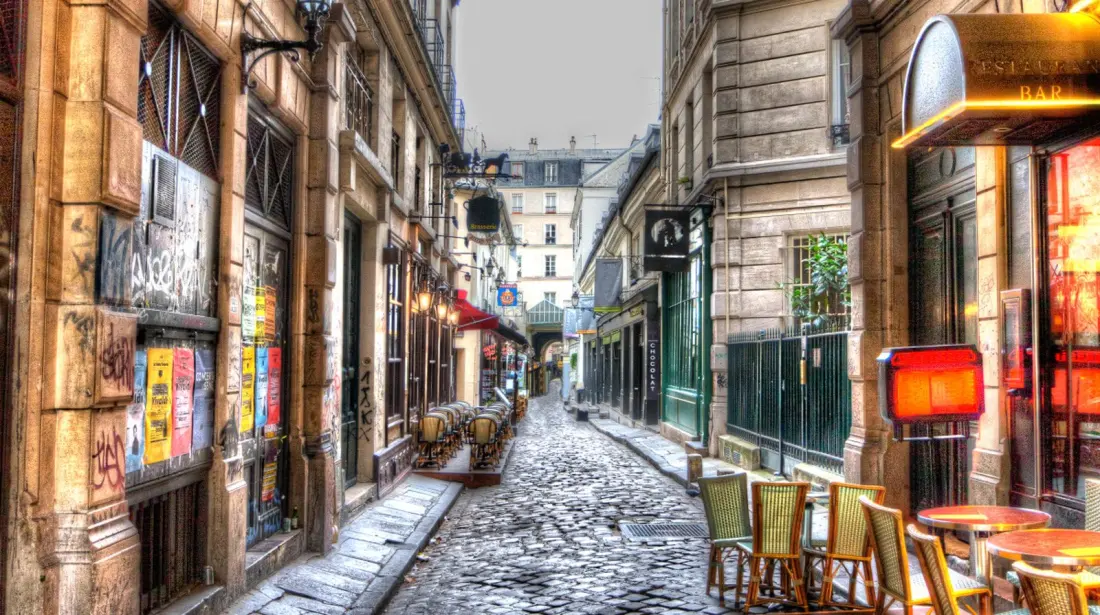
Long before shopping malls, Paris had the passages couverts — glass-roofed, pedestrian-only arcades built from the late 1700s onwards to shield shoppers from rain, mud and the clatter of carriage traffic. Around two dozen survive today, and they're one of the best free ways to see a quieter, more cinematic side of the city. Think vintage storefronts, muffled footsteps, old-fashioned lamps and curved glass ceilings overhead.
Start with Galerie Vivienne, near the Jardin du Palais Royal. Opened around 1807, it's arguably the most beautiful of the lot: a colourful mosaic floor, neo-classical stonework and a pointed iron-and-glass roof. Browse Librairie Jousseaume, a bookshop as old as the arcade itself, which also sells postcards, antiques and bookmarks.
Passage des Panoramas, near Palais Garnier, is another favourite and one of the oldest, dating to 1800 when American businessman William Thayer developed it. It's more eclectic than elegant these days — a stretch of upscale restaurants including Stern Ristorante and Astair, plus the wonderfully odd little museum Le Vistemboire des Panoramas, crammed with eccentric art and mismatched decor. There's also the historic Théâtre des Variétés; even if you skip the show, the interior is worth a peek for its ornate, century-old auditorium.
No two arcades feel alike. Some have checkered tile floors, others elaborate mosaic or stone reliefs; some are lined with wood-panelled shopfronts, others with off-white neoclassical walls. Between them you'll find second-hand bookshops, wine bars, stamp dealers, toy shops and cafés — a far better souvenir hunt than another Eiffel Tower keyring. Many were lost to Baron Haussmann's sweeping 19th-century redesign of Paris, which makes the survivors feel all the more precious.
Why bother? Because the passages show you how Parisians actually move through their city. They're warm in winter rain, cool in summer, and almost never crowded in the way the big boulevards are. Stumbling on one — an unmarked doorway off a busy street opening into a lit gallery — still feels like finding a secret, even when you're hunting for it.
Practically speaking: the passages are clustered around the Grands Boulevards in the 2nd arrondissement, so you can string several together in one unhurried afternoon on foot. If you'd rather have context as you go, Explore Paris runs guided walking tours covering multiple arcades with a guide who explains their history. Comfortable shoes and a flexible plan are all you really need.