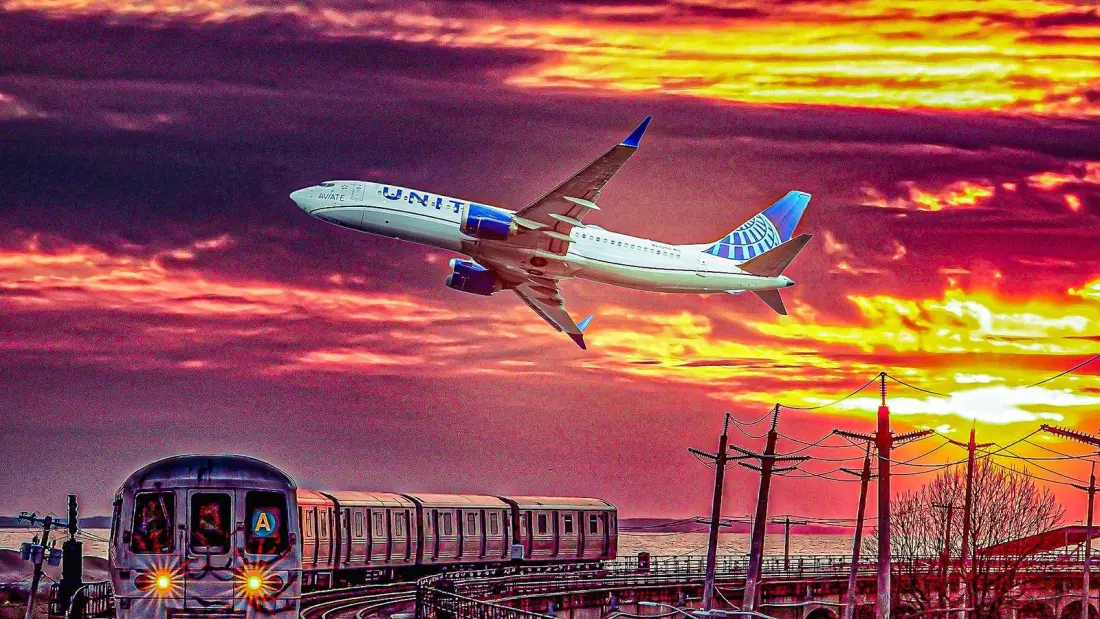
A routine cross-country flight turned into an unusual emergency when a 69-year-old woman became stuck inside a lavatory aboard a United Airlines Boeing 737 MAX 8 at 35,000 feet. The crew was eventually able to free her during a descent towards Chicago, and the plane carried on to its destination without further drama.
Flight UA1900 left Seattle-Tacoma on the morning of October 13, bound for Newark Liberty. About two and a half hours in, cabin crew discovered the woman could not get out of the rear lavatory — the door latch had jammed. They tried the standard outside release, then resorted to prying at the door with onboard tools. After roughly 15 minutes of failed attempts, the captain told air traffic control he wasn't prepared to leave a passenger confined for more than 20 minutes, and the crew began diverting to Chicago O'Hare. The 737 MAX had already descended to 27,000 feet for an emergency approach when the door finally gave way. With the passenger out and unharmed, the pilots scrapped the diversion, climbed back to 37,000 feet, and landed safely in Newark around four and a half hours after departure. United did not respond to requests for comment before publication.
What makes this worth noting is that it shouldn't be possible. Under FAA rule 14 CFR 25.820, airliner lavatory doors must be openable from the outside without special tools, precisely so nobody gets trapped. Normally a hidden override behind the lavatory sign lets flight attendants pop the lock in seconds. On this flight, the latch stayed stuck even when crew followed the standard procedure.
There's a pattern here, too. A United 737-800 diverted to Denver back in September 2019 after a passenger got stuck in a lavatory, and firefighters were needed to open that door. More recently, in April 2025, the FAA proposed an airworthiness directive covering more than 2,600 US-registered 737s — including the 737-700 through -900ER and the MAX 8 and MAX 9 — after a broken latch left another passenger trapped and forced an unscheduled landing. Investigators traced that failure to fatigue in the latch's plastic structure, and the FAA pegged repair costs at up to $1,302 per aircraft, potentially $3.4 million across US operators. Whether the latest incident involved the same defect hasn't been confirmed.
For travellers, the reassuring part is how the system worked: the crew monitored the situation, made a sensible call early, and the passenger came to no harm. The less reassuring part is that a known latch problem keeps resurfacing across the 737 family. If you've ever wondered why flight attendants occasionally linger near the aft galley, incidents like this are the reason — cabin crew are trained for far more than serving drinks, and occasionally they have to engineer their way into a locked lavatory at cruise altitude.
Simple Flying