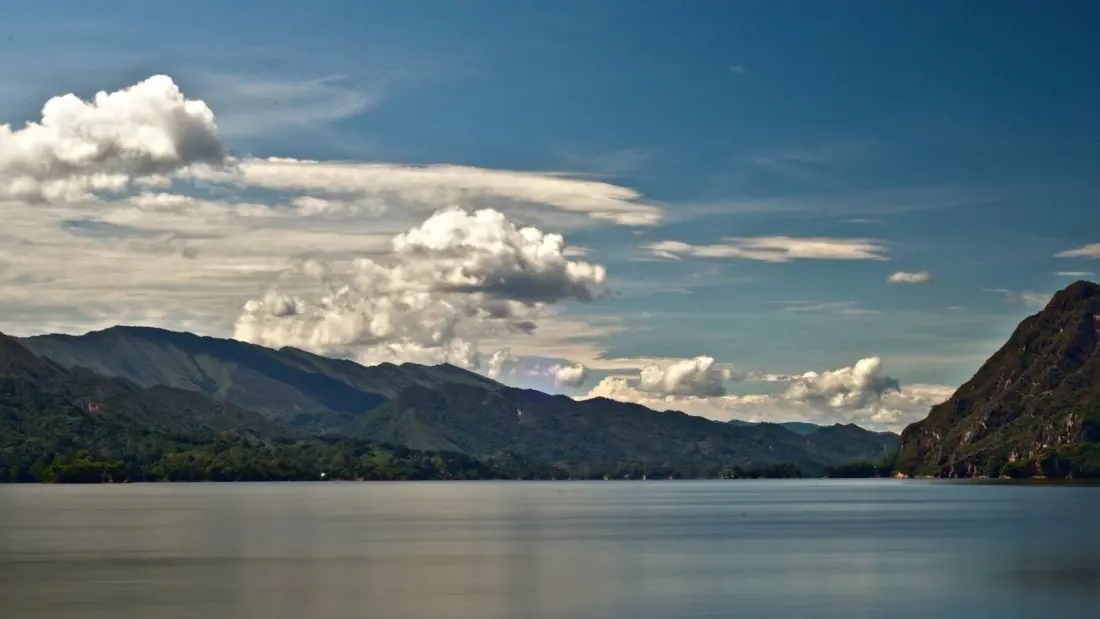
Two hours from Ibagué, the Darío Echandía Reservoir near Prado stretches across roughly 4,200 hectares of Tolima, ringed by green mountains. Locals call it Colombia's inland sea, and the nickname holds up: the water runs about 28 kilometres from south to north and drops to 90 metres deep at its maximum.
The lake wasn't made for tourists. Construction on the dam started around 1959–61 with German and Japanese firms directing the work, and the hydroelectric plant began operating in 1972. It still generates about 51 megawatts for parts of Tolima and Huila plus Girardot, and is managed by Celsia. Fed by the Cunday and Negro rivers, the reservoir sits within the Magdalena basin, and local fishermen still work it, mainly for tilapia. Tourism came later — the sheer size and scenery turned it into a weekend playground.
Almost every visit starts with a boat, since the headline sights sit along the shoreline. Tours typically stop at the Laguna Encantada, a pool walled in by tall rock formations that legend says never changes water level, and the Laberintos de Yacupi, rock passages carved along a geological fault that double as a birdwatching spot. There's also the Cueva del Mohán, a small cave with a narrow opening that lets in light and water, the Cañón de los Enamorados, and the 12-metre Cascada del Amor, where you can swim in the pool beneath the falls. The biggest island, the C-shaped Isla del Sol, has around 200 residents.
If lying on a boat isn't your speed, the water itself is the activity: swimming, water-skiing, canoeing, wakeboarding, jet skis, paddleboarding and inflatable rides are all on offer. Accommodation ranges from cabins and condominiums to campsites right by the shore, so it works as a budget trip or something more comfortable.
Getting there is straightforward. From Bogotá, drive south through Soacha and follow National Route 40 via Girardot, Espinal and Saldaña, then take the signed turn to Prado — the last stretch runs 30 to 40 minutes down to the pier, where boats leave for hotels and attractions around the lake. No car? Direct buses make the trip in roughly six hours.
For travellers who've done Colombia's Caribbean coast and coffee zone and want something quieter, Prado hits a sweet spot: big-water scenery you normally associate with coastal or lake destinations, but tucked into Andean foothills and reachable in a long weekend. It's a good pick for groups and families who want watersports without resort prices, and for anyone curious about how a piece of 1970s energy infrastructure became one of central Colombia's favourite summer escapes.