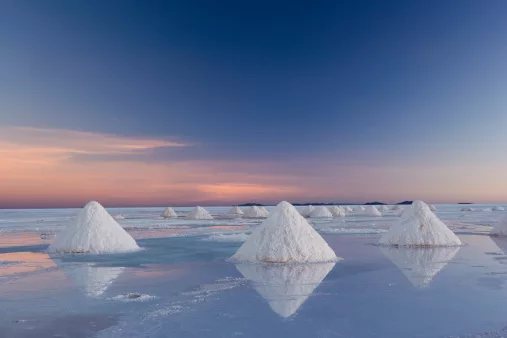
There are few places on Earth where the horizon genuinely stops making sense. Salar de Uyuni in southwestern Bolivia is one of them. Covering roughly 10,582 square kilometres on the high Altiplano at about 3,650 metres above sea level, it's the world's largest salt flat — the dried-out remnant of prehistoric lakes that slowly evaporated, leaving behind an enormous crust of salt so flat that, after rain, it reflects the sky like a vast natural mirror.
That mirror effect is the reason it has become one of South America's most photographed landscapes. Between roughly December and March, shallow water spreads across the salar and, on still days, clouds and distant mountains appear beneath your feet. It's not guaranteed — reflections depend on water depth, wind and surface smoothness, and conditions vary across the flat — but when it works, the effect is disorienting in the best way. The trade-off is practical: heavy rain can close routes, limit which islands tours can reach, and occasionally force itinerary changes.
The dry season, from about May to November, offers a completely different scene. The water evaporates and the salt crust emerges with intricate polygonal patterns formed by crystallisation and brine movement beneath the surface. Access is easier and more of the flat is open to vehicles, and sunrise and sunset excursions are especially rewarding.
Either season, most visits include Isla Incahuasi, a rocky island in the middle of the white expanse covered in giant cacti — some centuries old — with walking trails and viewpoints over the salt. During the rainy months, check with your operator whether the island is reachable.
Most travellers use the town of Uyuni as their base, flying in or travelling overland from La Paz. Tours run from day trips to multi-day 4x4 expeditions, and many extend beyond the salar into the wider Altiplano: the Eduardo Avaroa reserve, mineral-stained lagoons with flamingos, geysers and desert scenery. Some routes even finish at the Chilean border, linking up with San Pedro de Atacama. You can also start excursions from Tupiza in Bolivia or from Atacama itself.
Two things deserve real planning attention. First, altitude: the salar sits at 3,650 metres and multi-day routes go higher, so allow time to acclimatise, hydrate, and know the warning signs of altitude sickness. Second, conditions: pack warm layers for cold nights and early starts, sunglasses and sunscreen (the salt reflects fierce sunlight), and waterproof gear in the wet months. Choosing a reputable operator matters too — compare what's included, check vehicle condition and driver experience, and ask about emergency arrangements, accommodation and meals before booking.
Whether you come for the mirror or for the endless geometric white, Salar de Uyuni rewards travellers who time their visit to the experience they want. Flexible itineraries and a decent camera are both strongly recommended.