San Salvador's Centro Histórico is the old heart of El Salvador's capital, built around three squares — Plaza Libertad, Plaza Gerardo Barrios and Plaza Morazán — all close enough to cover on foot in a morning. It's not a preserved Spanish colonial quarter, and that's the interesting part. Earthquakes and fires have flattened the city repeatedly since the colonial settlement moved to this valley in 1545, so downtown is a patchwork of neoclassical facades, mid-century concrete and brand-new landmarks rebuilt over the ruins.
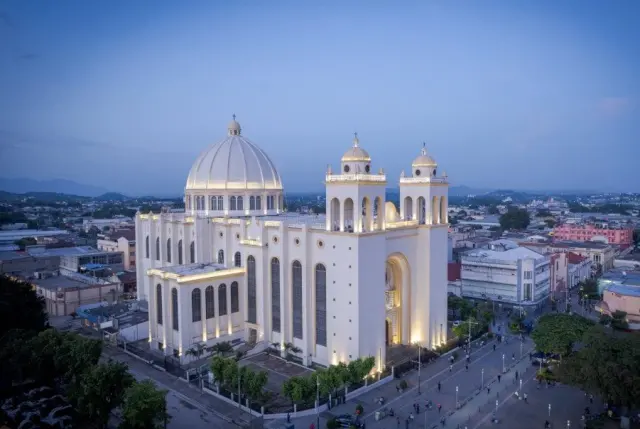
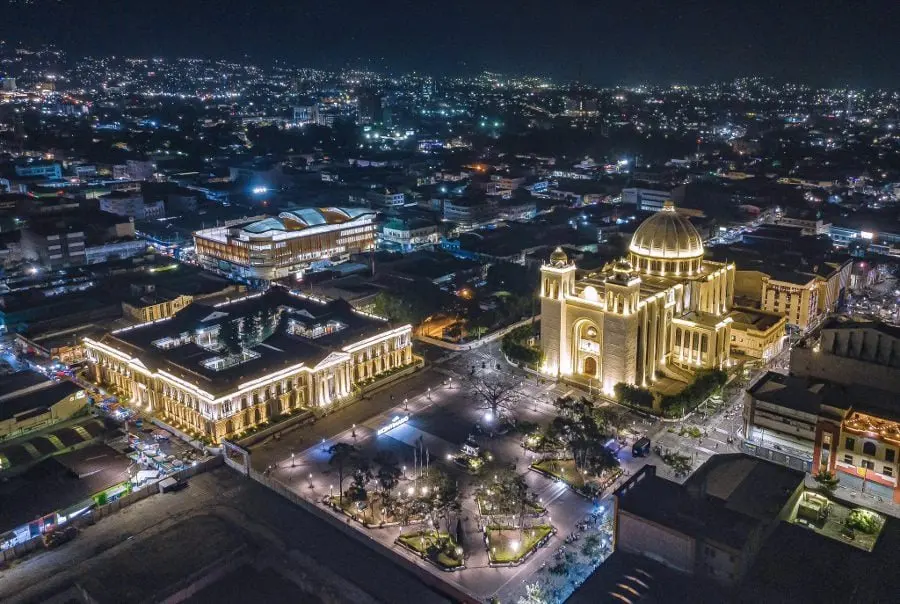
The headline sight is the Metropolitan Cathedral on Plaza Gerardo Barrios, the country's most important Catholic church and the resting place of Saint Óscar Romero, the archbishop assassinated in 1980 — which makes it a genuine pilgrimage site, not just a photo stop. Across the square sits the early-20th-century National Palace, with its courtyards and ceremonial rooms open to wander.
A short walk away, El Rosario Church near Plaza Libertad is the district's surprise. Designed by Salvadoran architect Rubén Martínez, it's a curved concrete shell with a rainbow of stained glass that floods the interior with colour in the afternoon. It looks nothing like a traditional church, and that's exactly why people love it.
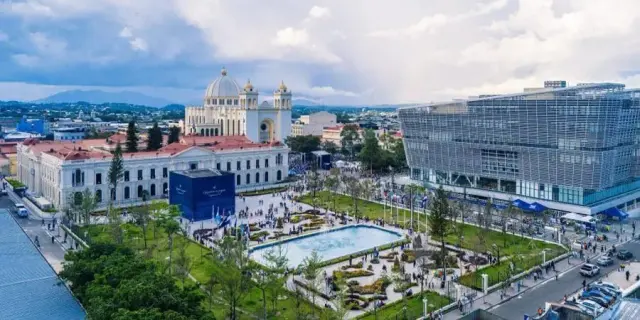
Culture fans should squeeze in the National Theater, open since 1917 with elegant European-inspired interiors, and the new BINAES national library, a striking modern building that has become the district's contemporary anchor. Plaza Libertad itself holds the Monument to the Heroes commemorating Central American independence, and Plaza Morazán honours Francisco Morazán, the 19th-century leader of Central American unity.
The practical appeal is that nearly everything clusters within a few blocks. A sensible loop: start at Plaza Libertad, walk to the cathedral and palace via Plaza Gerardo Barrios, then finish at Plaza Morazán and the theater. Between landmarks, dip into the commercial streets for pupusas, coffee and local drinks — downtown remains the capital's traditional trading quarter, so the street life is as much an attraction as the buildings.
After years of decline, the area has been spruced up: restored buildings, more pedestrian-friendly streets and the new library have brought visitors back. It gets a different mood after dark, when the monuments and churches are lit up, though many travellers prefer to explore with a guide or stick to daylight hours and take a taxi in and out.
Who it's for: anyone interested in history, architecture and photography, plus travellers pairing the capital with El Salvador's volcanoes, Ruta de las Flores or the Pacific surf coast. The district also resonates for Salvadoran diaspora visitors returning to see familiar landmarks — and Holy Week processions here are among the country's most significant.