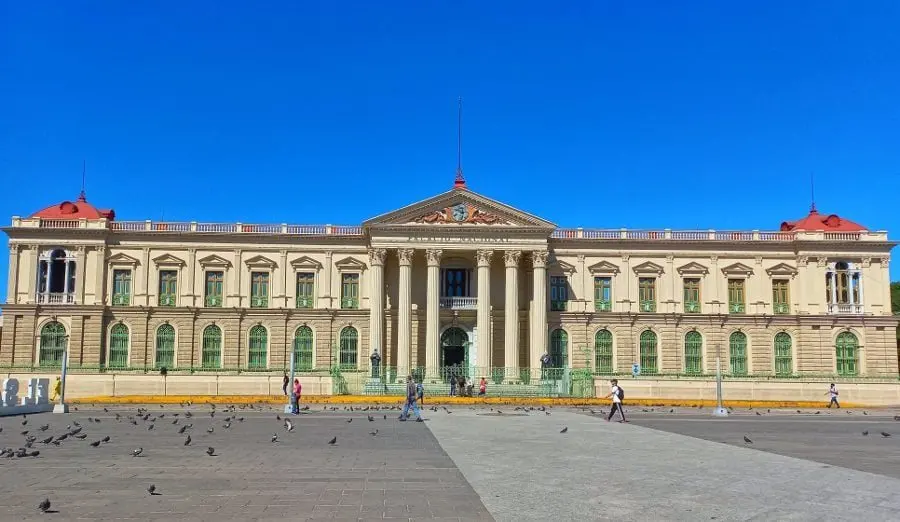
El Salvador's National Palace sits right on Gerardo Barrios Plaza in downtown San Salvador, and it's one of those buildings travellers often photograph on the way to somewhere else. That's a mistake. This was once the seat of all three branches of government — executive, legislative and judicial — and today it works as a museum where you can walk through the rooms where Salvadoran politics actually happened.
The backstory is genuinely odd and worth knowing before you visit. The original palace, built between 1866 and 1870, burned down in 1889. A design competition in 1903, won by engineer José Emilio Alcaine, produced the current building, which started rising in 1905. Here's the fun part: the state taxed itself one colón per exported quintal of coffee to fund construction, which earned it the nickname Palacio del Café. German-made metal supports were used to help the structure survive earthquakes — a sensible choice in this part of the world. It opened on 1 March 1911.
Architecturally, it's eclectic: a neoclassical frame dressed up with Renaissance, Baroque, Gothic and Art Nouveau details, roughly 74 metres per side, wrapped around a Greek-cross-shaped central courtyard that floods the interior with natural light. The main halls are named for their colours, and each had a job. The Blue Hall (Salón Azul) housed the Legislative Assembly, with its old seating and press section still in place. The Pink Hall was the Supreme Court's home from 1911 to 1974 and holds a painted version of El Salvador's first coat of arms. The Red Hall hosted presidential ceremonies and diplomatic receptions, while the Yellow Hall served as the presidential office until 1930. The Jaguar Hall breaks from the European-heavy interiors with imagery drawn from Indigenous mythology. The whole building was declared a national monument in 1980; the Blue Hall had already earned that status in 1974.
Why bother? Because San Salvador's historic centre is compact and very walkable, and the palace anchors it. The Metropolitan Cathedral — burial place of Saint Óscar Romero — is across the plaza. The striking modern National Library (BINAES) is next door, the 1917 National Theatre is nearby, and a short walk takes you to El Rosario Church, where rainbow stained glass does most of the talking. You can realistically cover the palace and two or three of these in a half-day.
This one's for travellers who want more from El Salvador than surf breaks and volcano hikes — history-minded visitors, architecture fans, and the large Salvadoran diaspora reconnecting with the country. Take a guided tour if you can; knowing the coffee-tax story and which hall did what turns pretty rooms into a proper history lesson. Exhibitions rotate, so repeat visits aren't wasted either.