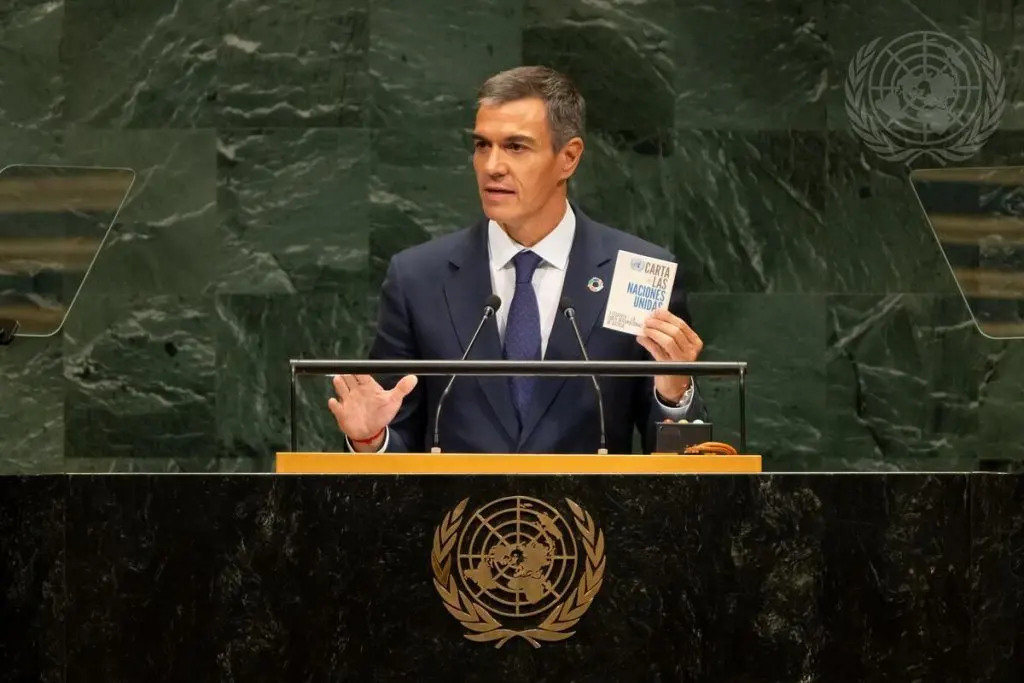
Spanish Prime Minister Pedro Sánchez used his address to the UN General Assembly in New York to frame the migration emergency in Ceuta as a test of values, telling world leaders that Spain will not respond to pressure by demonising migrants or abandoning international law.
The context is a crisis that overwhelmed the small Spanish enclave on the North African coast. On 30-31 July, more than 70,000 migrants crossed into Ceuta from Morocco in one of the most serious irregular migration events Spain has faced in years. Most were returned to Morocco, but thousands stayed, stretching the city's capacity for housing and basic services. With fresh calls circulating online for new mass attempts on the Ceuta and Melilla borders, Moroccan police have mounted large deployments on both fronts, and Sánchez acknowledged that effort while stopping short of blaming Rabat — although he admitted a day earlier that Morocco's border-control system had failed, and that Spain had demanded explanations. A Spanish court is also looking into whether the surge was a deliberate 'hybrid warfare' operation.
In his speech, Sánchez argued that 'inequality, desperation and disinformation' drove the crisis, and ruled out the shortcut of mass expulsions without individual case reviews. He praised the people of Ceuta for confronting the emergency 'without giving up decency'.
The Ceuta crisis was one thread in a much wider address. Sánchez attacked what he called 'selfish, ignorant and cruel' political forces, took an oblique swipe at US aid cuts — describing a 'chainsaw' that has shrunk global development assistance by nearly a third in two years while Spain doubled its own cooperation spending — and repeated his government's accusation that Israel's Netanyahu is committing genocide in Gaza. He defended refusing to raise defence spending to 5% of GDP, called for reform of the UN Security Council and an end to permanent members' vetoes, urged regulation of what he called 'tech oligarchs', and pushed for the next UN secretary-general to be a Latin American woman.
For travellers, the practical picture matters more than the rhetoric. Ceuta and Melilla remain Spanish territory on African soil, popular with visitors crossing between Europe and Morocco by ferry. Border controls on the Moroccan side have been tightened and can change quickly; anyone planning to cross overland between Morocco and the Spanish enclaves should check conditions before travelling and expect queues or temporary closures. Ferry routes from Algeciras to Ceuta and from Málaga or Almería to Melilla continue to run normally, and daily life for visitors in the enclaves has been unaffected by the political standoff.
The story is ultimately about how a frontline destination handles a humanitarian emergency in full view of the world — and for now, Spain's government has staked its answer on law and rights rather than walls.
Reporting by Spain in English.