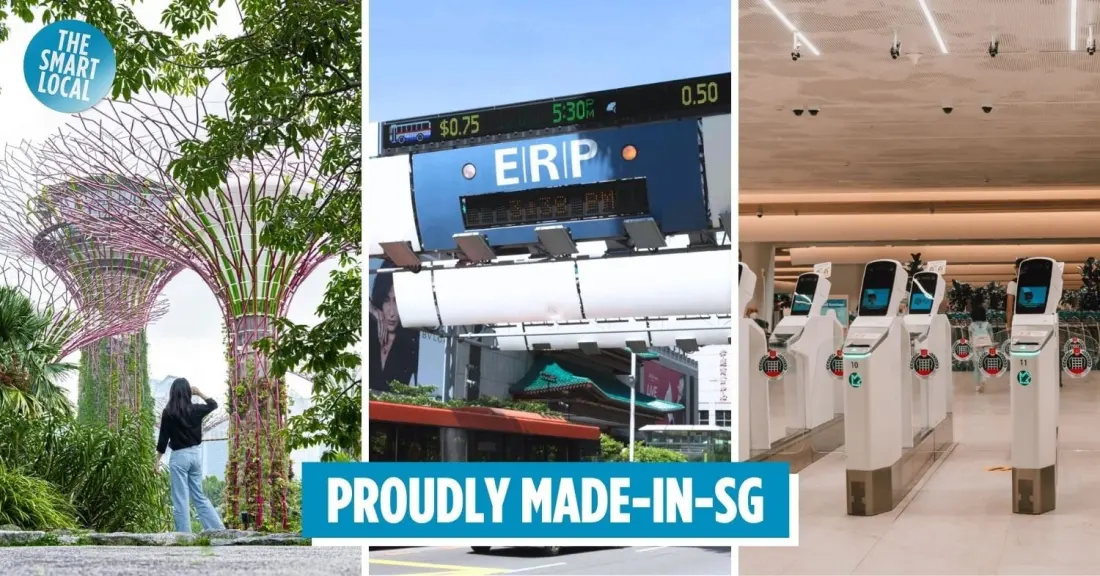
Singapore doesn't look like an invention hub at first glance — no vast farmland, no natural water sources, barely any space to spare. That's exactly why it became one. Forced to solve hard problems early, the city-state produced systems that now shape cities far beyond its borders, and several of them are things travellers actually walk through, drink, and benefit from without noticing.
Take congestion pricing. Singapore introduced the world's first urban congestion charge back in 1975, when drivers had to display a paper licence to enter the city during morning peaks. In 1998 it upgraded to the Electronic Road Pricing (ERP) — the first full-scale automated electronic road pricing system — which London and Stockholm later followed with their own schemes. The next iteration, ERP 2.0, is now phasing in satellite-based charging instead of gantries.
Water is an even bigger story. NEWater, publicly launched in 2002 after decades of research, treats used water through microfiltration, reverse osmosis and UV disinfection until it exceeds WHO and US EPA drinking standards across some 20,000 tests — clean enough for semiconductor factories. The World Bank calls Singapore's shift from scarcity to resilience a global benchmark, and the Singapore Water Centre opened in 2024 to share that know-how with other water-stressed nations.
Food gets the vertical treatment too. Greenphyto's indoor farm in Jurong West opened this January with hydroponic towers 23.3 metres tall — a Guinness World Record for the tallest vertical farm grow rack. Twelve stacked levels hold 500 racks of greens per tower, targeting around 2,000 tonnes of vegetables a year, all run by AI, robotics and predictive analytics in a climate-controlled space.
Then there are the icons with hidden engineering. The 18 Supertrees at Gardens by the Bay, standing 25 to 50 metres tall, are living sculptures — but 11 of them do real work, with photovoltaic cells powering their night-time lighting and some venting hot air from the conservatories. Those conservatories cut cooling energy by roughly 30% using specialised glass, displacement cooling and energy recovery, an approach engineers study for hot, humid cities across Asia and the Middle East.
Travellers pass through two more of these innovations directly. Changi Airport, with 722 Best Airport awards and 14 Skytrax world titles, pioneered end-to-end automated departures with its FAST system at Terminal 4 in 2017; today facial and iris biometrics can get residents through immigration without a passport. And the Port of Singapore — one of the world's largest transhipment hubs, run by PSA with terminals across 45 countries — moves the cargo behind those airport arrivals, with Tuas Port set to become the world's largest fully automated container terminal by the 2040s, capable of 65 million TEUs a year.
For visitors, this is a good reason to look closer at Singapore beyond the usual eating and shopping itinerary. Book the Gardens by the Bay conservatories and you're touring genuine cooling engineering; fly through Changi and you're experiencing the benchmark other airports chase. It's practical, mildly nerdy travel — and it makes the city's slickness make sense.
Story via The Smart Local