Every hiker knows the feeling: the climb went fine, but halfway down the mountain your thighs are burning and the fronts of your knees are throbbing — and they stay cranky for days. A new training guide from Outside Online explains why downhills hurt so much, and offers six exercises to fix it.
The culprit, according to orthopedic physical therapist Tom Walters, is eccentric loading. When you walk downhill, gravity pulls your knee into a deeper bend with every step, and your quads have to lengthen under tension to act as a brake. That constant controlled braking is exactly the kind of work that triggers muscle soreness and irritates the patellar tendon, which attaches to the kneecap — hence the ache at the front of the knee after a long descent.
The fix is straightforward: build stronger quads and tougher tendons so the tissue can handle the load. Trainer Jenny McCoy and Walters laid out six moves, ordered easiest to hardest, and their advice is to pick just one to three that suit your level and do them two to three times a week — not all six at once.
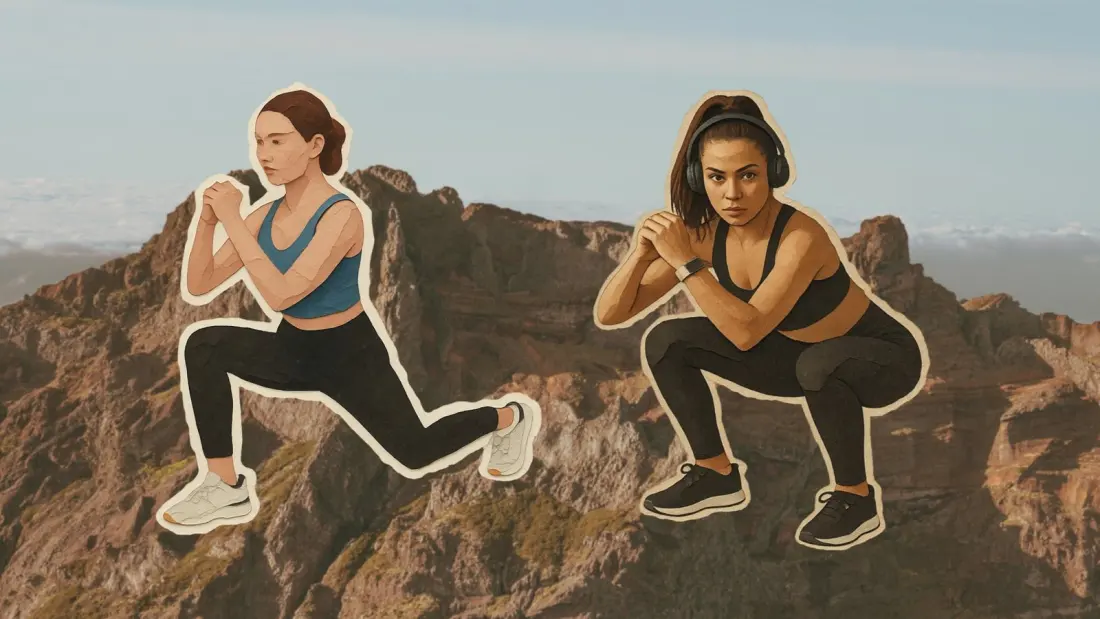
The list starts with wall sits (slide down a wall to a 90-degree knee bend, hold 30 to 60 seconds, four to five reps) and goblet squats with a heavy dumbbell held at the chest, which keeps your torso upright and shifts the work onto the quads. From there it moves to forward lunges, which Walters flags as especially transferable to hiking because the deceleration as you step forward mimics downhill braking.
The last three are the most hiking-specific. Step-downs from a box train you to lower one leg to the ground with control — basically a rehearsal for a rocky descent — while single-leg sit-to-stands from a bench build the unilateral strength most people lack. The final move, a double-leg hop to single-leg landing, is about power rather than strength: it teaches your patellar tendons to absorb and release energy, which is what you need when you're catching yourself on an uneven trail. Walters cautions that this one should be done on fresh legs, ideally at the start of a workout, since sloppy, wobbly landings raise injury risk.
Why should this matter to travellers? Because the hike itself is only half the preparation. Plenty of trips — the Tour du Mont Blanc, the Inca Trail, a descent into the Grand Canyon — involve hours of downhill walking, and arriving with untrained quads can turn a dream trek into a knee-braced shuffle. A few short strength sessions a week in the lead-up is a cheap insurance policy, and you only need a dumbbell, a step, and a chair.