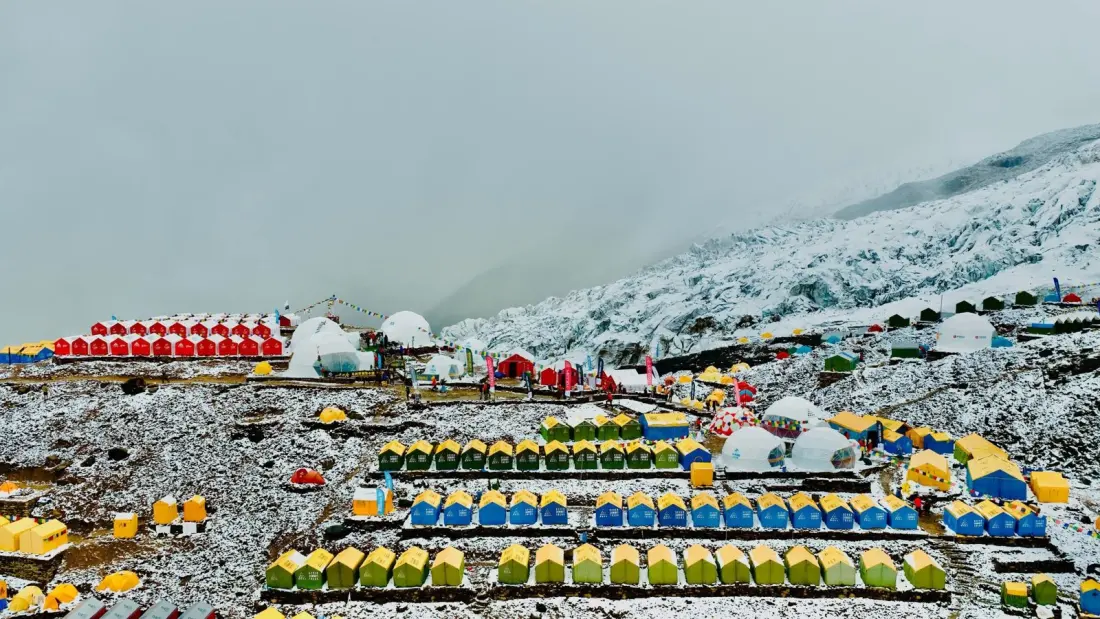
A deep Bay of Bengal depression is bearing down on Nepal's Himalaya just as a record autumn climbing season peaks, and more than 1,000 climbers and guides on Mt Manaslu are sheltering at base camp waiting to see how it plays out.
Manaslu, the world's eighth-highest mountain at 8,163m, is the star of Nepal's autumn climbing window. This year it has drawn 480 foreign permits — more than Everest did in its crowded spring season — plus roughly 500 Nepali high-altitude guides and support staff. The government's Mountaineering Division has collected $1.479 million in climbing fees alone. Many treat Manaslu as an acclimatisation run before spring attempts on Everest, which explains the surge.
The season has already been grim. On 20 September an avalanche at Camp III killed German climber Dhruba Jyoti Guha and his Nepali guide Phursemba Sherpa. A 50-year-old Singaporean climber died during an acclimatisation descent at 6,000m, and 20-year-old guide Tashi Sherpa was asphyxiated by generator exhaust in his tent at base camp. Meanwhile, ropes fixed to the summit on 17 September — opening the route for everyone else — were partly buried by an avalanche the day before. Sherpa reconnaissance teams reported up to 80cm of snow sitting at Camps I and II.
The incoming system entered India's east coast on Tuesday morning and is forecast to bring heavy rain and snow to central and western Nepal from 24-27 September. Some models project 400-740mm of rainfall and blizzard conditions at altitude, though a stronger-than-usual westerly jet stream could deflect the storm — a similar cyclone fizzled out last year before reaching Nepal. Its eventual track remains genuinely uncertain.
Expedition teams are playing a waiting game. Some climbers on Makalu pushed for a summit bid on Tuesday and Wednesday to beat the weather, potentially with no rest days after their Camp III rotation. If a short clear window opens afterwards, guides expect a rush of simultaneous summit attempts — and the prospect of traffic jams on Manaslu's knife-edged summit ridge. As lead guide Lakpa Sherpa put it, patience and the mountain will decide the timing.
For travellers, this is a useful reality check on Himalayan trekking and climbing in late September. The monsoon doesn't always respect the calendar, and a trip scheduled for the traditional start of the autumn season can collide with serious mountain weather. Anyone heading to the Manaslu region, Annapurna or the Everest approach trails in the coming weeks should watch forecasts closely, build flexible itineraries and heed local operators — the same storm that strands climbers also triggers landslides and trail closures at lower elevations.