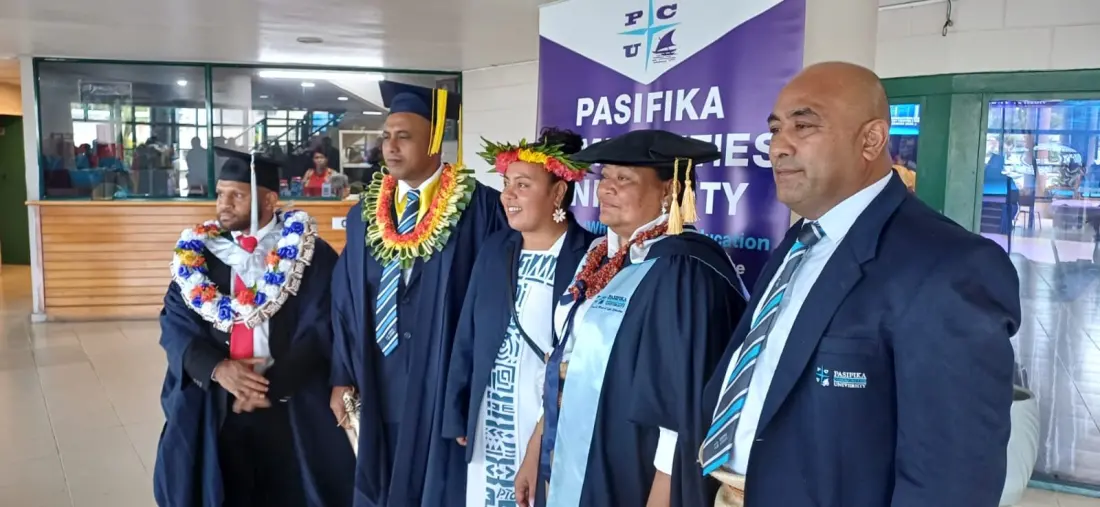
Fiji's capital hosted a milestone moment for Pacific education this week, as the region's newest university, Pasifika Communities University in Suva, graduated 140 students. Fiji's Education Minister Aseri Radrodro officiated the ceremony.
The class of 2026 was notably diverse in both qualification level and origin. Five students earned Doctor of Philosophy degrees, four completed Masters in Theology, and five received Postgraduate Diplomas. Four graduated with Bachelors in Divinity, while the majority — more than 120 — collected diplomas and certificates.
The student body reflected how far the university's reach now extends. Graduates came from American Samoa, Fiji, Kiribati, New Caledonia, Papua New Guinea, Samoa, Solomon Islands, Tonga and Vanuatu — and, in a sign of the institution's unexpected international pull, from Spain as well.
For a young university, that spread is significant. Suva has long been the Pacific's educational hub, hosting the region's established institutions and drawing students from island nations across Melanesia, Micronesia and Polynesia. Pasifika Communities University's first big graduating class suggests it is joining that tradition, offering study pathways — particularly around theology and community-focused programmes — that students once had to leave the region to find.
Why does this matter to travellers? Suva is often a transit point rather than a destination, but stories like this underline what the city actually is: the Pacific's administrative and academic capital, with a student population that brings together cultures from across the ocean. If you're passing through Fiji, it's a good excuse to look beyond the resort strip — the city's markets, colonial architecture and harbourfront give a very different read on Fiji than the Mamanuca islands. And with stronger local institutions, the region's connectivity, events calendar and community tourism offerings only tend to grow.
Full details of the ceremony come via Islands Business.