
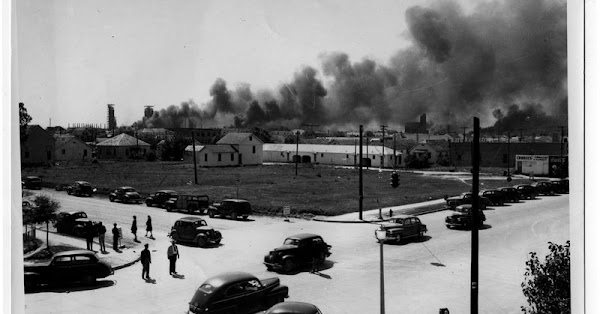
On 16 April 1947, spectators gathered along the waterfront of Texas City, a Gulf Coast port south of Houston, to watch firefighters tackle a smoking cargo ship. Minutes later, the French vessel SS Grandcamp blew up with such force that the event is still counted as the deadliest industrial accident in United States history — a story that still shapes how the town remembers itself today.
The Grandcamp was loaded with roughly 2,300 tons of ammonium nitrate, a wartime explosive ingredient repackaged after the war as fertiliser. When smoke appeared in a hold, the captain ordered it sealed and steamed rather than flooded, worried about ruining the cargo. The heat and confinement likely made things worse; the fire burned on until, at 9:12 a.m., the ship detonated.
The scale of the blast is hard to overstate. A two-ton anchor was thrown more than a mile and a half inland, landing in a ten-foot crater. A fifteen-foot tidal wave swept the waterfront, and windows shattered eight miles away in Galveston. Warehouses, rail yards and the Monsanto chemical complex near the docks were obliterated, and burning debris set off oil and chemical storage tanks across the industrial district. Nearly the entire Texas City volunteer fire department died at the scene; only one member survived.
Worse followed. A second moored ship, the SS High Flyer, carrying about 1,000 tons of ammonium nitrate and 2,000 tons of sulphur, caught fire and drifted. Despite frantic attempts to tow it clear, it exploded shortly after 1:00 a.m. the next day, destroying another vessel, the SS Wilson B. Keene.
The final toll: at least 581 dead — some historians believe hundreds more, including seamen and undocumented workers, went uncounted — over 5,000 injured, and 2,000 left homeless. Galveston was coated in oily fallout. The aftermath produced Dalehite v. United States, a landmark Supreme Court case brought by some 8,500 plaintiffs against the federal government, which won in 1953. Congress eventually distributed about $16.5 million to victims through a special 1956 settlement act.
For travellers passing through the Houston–Galveston area, the physical memory of the disaster is still visible. The Grandcamp's giant anchor sits in a Texas City memorial park, its smaller anchor rests on a Texas-shaped memorial at the entrance to the Texas City Dike, and a propeller from the Wilson B. Keene lies nearby. The town's memorial museum tells the full story — a sobering, worthwhile stop that pairs naturally with the beaches and attractions of Galveston just across the bay.
It's a reminder that some coastal towns carry histories as compelling as any beach day, and that a detour into Texas City offers one of the most powerful industrial-history stories in America. Credit: Amusing Planet