
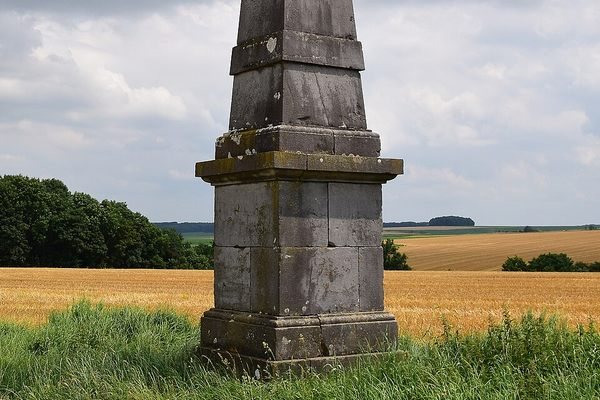
Drive out of the hamlet of Verlée in Belgium's Condroz region, heading towards Petit Avin, and you'll spot something odd on a ridgeline: a plain stone obelisk rising from empty fields, with no plaque, no inscription and no explanation. Only carved garlands at its top hint at its age — early 19th century, Empire era. Locals and internet pages alike have long dubbed it 'Belgium's only pyramid'.
The internet's favourite theory ties the monument to Colonel Jean-Joseph Tranchot, who ran a triangulation survey of the Rhine region and a sliver of northern Belgium between 1801 and 1813. It sounds convincing: the obelisk sits prominently on a hilltop, other surviving survey markers are obelisks too, and the dates match the decoration. But it falls apart on one point — Tranchot's preserved maps never covered this area.
The real answer was hiding in old maps. Roughly 750 metres north-north-east of the obelisk once stood a castle, the Château de Bouillon (not to be confused with the famous fortress in southern Belgium, now gone entirely). Rue Haveligeoule, the road leading to the pyramid, runs exactly along the line between the two sites, and one face of the monument is precisely aligned with that axis. In other words, this isn't a survey marker or a mystical relic — it's the terminus of a grand garden axis.
That design trick has royal roots. Versailles set the template in the 17th century: a monumental central vista stretching over eight kilometres eastwards, a statement of the king's reach across his realm. French-style gardens across Europe copied the idea at palaces like Het Loo in the Netherlands, Wilhelmshöhe in Germany, Vaux-le-Vicomte in France and La Hulpe Castle in Belgium. Where terrain made a full axis impossible, owners planted a decorative monument instead as a focal point for the view. Verlée's pyramid is one of those — a bit of Versailles-era vanity in a sheep field.
Why bother with a stone lump in the countryside? Partly for the story: it's a neat case study in how misinformation spreads, since even the 'Belgium's only pyramid' nickname is wrong once you know its true function. Mostly, though, it's a good excuse to explore the Condroz, a gently rolling corner of Wallonia stacked with castles and walking routes. The obelisk sits at the junction of Chemin de la Pyramide and Rue Haveligeoule, and it's just 7 km from Modave Castle, famous for its ornate guard-room ceilings. Brussels is about 75 minutes away by car, making this an easy day trip for anyone who likes their sightseeing slightly off-script.
Story via Atlas Obscura.