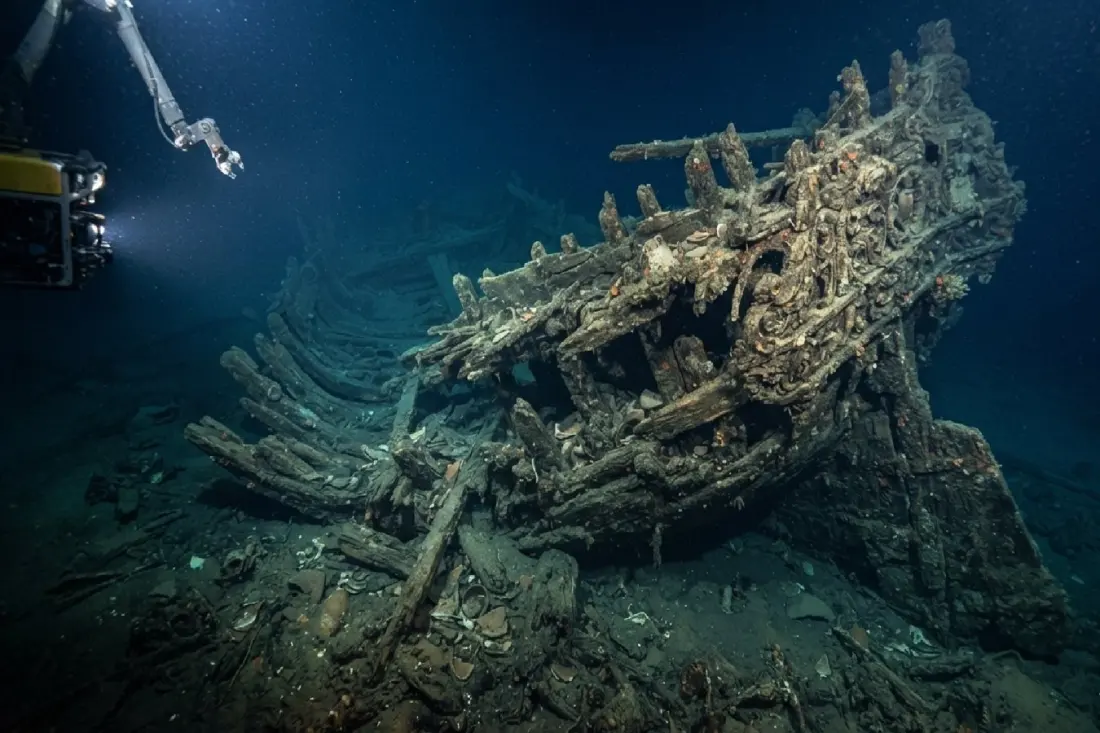
Six hundred metres down in the Caribbean, about 20 kilometres from Cartagena, lies one of the most valuable and most studied shipwrecks in the world: the San Jose galleon, sunk by a British squadron in 1708 during the Battle of Baru. Last year Colombian authorities lifted five objects from the site — a cannon, a porcelain cup and three macuquina coins — a tiny taster of the gold, silver, emeralds and Chinese porcelain that went down with the ship as it sailed from Portobelo, Panama toward Cartagena de Indias.
But the newest findings from the San Jose aren't about treasure at all. Colombian archaeologist Ricardo Borrero Londoño, a member of the Colombian Institute of Anthropology and History (ICANH) and its underwater heritage project on the wreck, has been studying the ship's wooden structures and hull design. His chapter appears in a new two-volume academic book, "Brief History of Iberian Ship Conception and Design (1570-1712): The Coordinate System that Preceded Descartes," published worldwide by Springer Nature on September 18.
The book's argument is striking: Iberian shipbuilders were using systems to precisely represent the curves of hulls and masts before René Descartes published his coordinate geometry, and before anything resembling modern ship plans existed. In other words, the galleons that crossed the Atlantic were among the most advanced engineering projects of the scientific revolution — applied mathematics you could sail.
The second volume, which carries the San Jose research, traces how galleons evolved by pulling together archaeology, naval engineering and the history of science. It also compares structural components from the handful of 17th-century Iberian wrecks that have been properly excavated rather than stripped by treasure hunters — a short list the San Jose now anchors. Borrero Londoño, a Fulbright scholar with a PhD in nautical archaeology from Texas A&M, says the work offers a new framework for understanding how vessels of the period were conceived and built.
For travellers, this adds depth to any trip to Cartagena. The city's old town, walls and forts were built largely to protect the very treasure fleets the San Jose sailed with, and the wreck sits in waters you can dive or explore by boat. The story is also a reminder that Colombia's Caribbean coast is an active frontier of underwater archaeology, not just a backdrop of colonial architecture and Caribbean beaches. Expect the San Jose to keep making headlines as recovery work continues — and for Cartagena's museums and maritime heritage to grow along with it.
Who's it for? History-minded travellers heading to Colombia's Caribbean coast, divers curious about deep-water archaeology, and anyone who likes the idea that a shipwreck can reshape what we know about science itself.
Story via Colombia One.