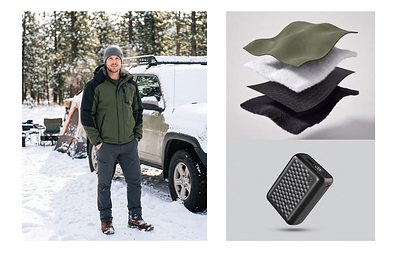
Heated jackets and vests have quietly become a winter travel staple — on ski lifts, in icy city streets, on long-haul flights where the cabin turns arctic. But if you've ever hesitated about strapping a lithium battery to your chest for hours, a new round of testing and certifications from heated apparel brand Wulcea speaks directly to that worry.
The company, which builds its garments around a flexible graphene-based heating system it calls GrapheneNano, has published details of the safety and durability work behind its products. The heating elements are designed to spread warmth across the upper body without stiffening the garment, so a heated jacket still moves like a jacket. On paper, the kit carries compliance documentation for major markets: CE and FCC for electrical and electromagnetic standards, PSE for Japan, and RoHS covering restrictions on hazardous substances in components.
The batteries get the deeper scrutiny. Wulcea's rechargeable packs are UL certified, which means independent evaluation of overcharge protection, short-circuit protection and thermal safety. They also carry CE and FCC documentation, RoHS material-safety compliance, and UN 38.3 testing — the standard that governs whether lithium batteries can legally be transported internationally. That last one matters more than most shoppers realise, since it's the same testing regime that determines whether you can fly with a power bank in the first place.
Durability claims are unusually specific. The graphene heating elements are flexed 10,000 times in testing to survive bending and everyday movement, and the garments are rated to hold up through 100 machine-wash cycles while keeping their internal conductivity intact. Built-in NTC temperature sensors monitor heat and cut the heating off if temperatures climb past 131°F (55°C). On a full charge at the low setting, the company claims up to 10 hours of runtime, with a control button tucked inside the garment and batteries housed in dedicated interior pockets to keep the silhouette clean.
For travellers, the practical upshot is a checklist you can borrow when shopping any heated apparel, not just this brand. Look for UN 38.3 compliance if you plan to fly with the garment, UL certification on the battery for peace of mind, and washability ratings if you'll be on the road for weeks. Flexible heating zones and a long low-setting runtime are the difference between a gimmick and something you'll actually wear on a December walk through Helsinki or a January morning in Hokkaido. Wulcea's pitch is that certified components and flex-tested elements are what turn heated clothing from a novelty into dependable cold-weather gear.
The announcement, released via PR Newswire and covered by Laotian Times, is essentially a trust-building exercise — founder John C frames it as giving users confidence in battery safety rather than just warmth. Whether it moves the market is another question, but it does signal where heated apparel is heading: fewer vague promises, more documented engineering.