
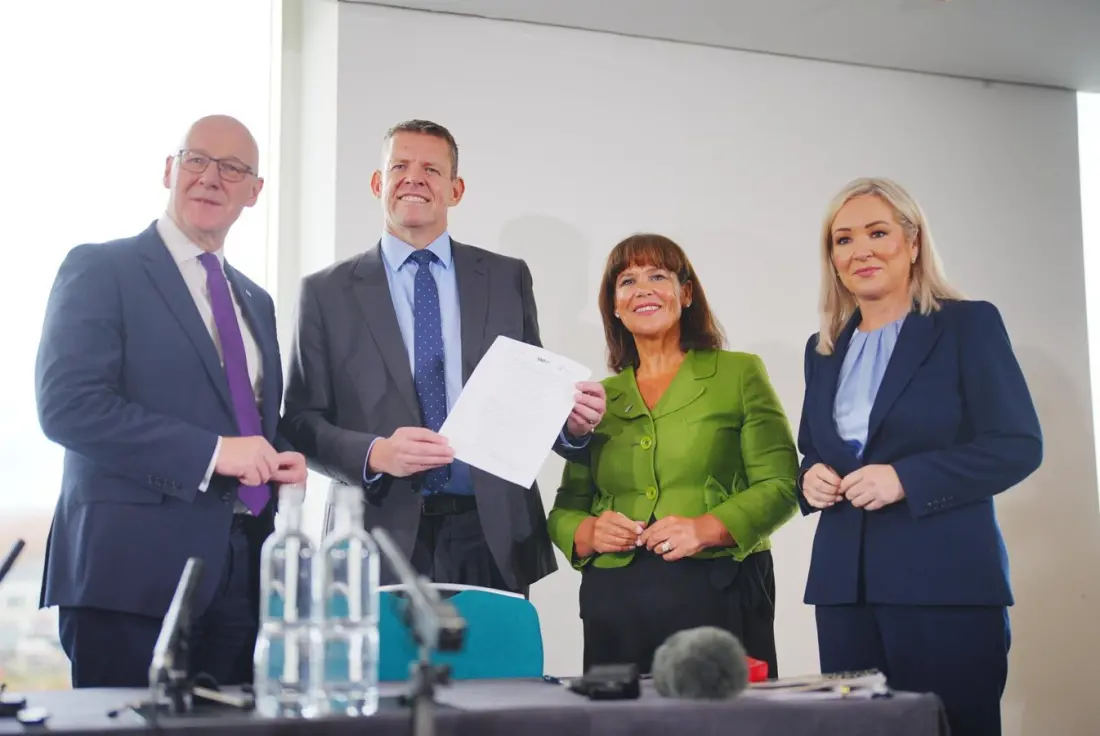
The leaders of Scotland, Wales and Northern Ireland have signed a joint memorandum of understanding telling Prime Minister Andy Burnham's government to get ready for constitutional change — and signalling that they see their countries' futures inside the European Union rather than the United Kingdom. It's the first time all three nations have simultaneously been led by pro-independence parties, or by a pro-unification party in Northern Ireland's case.
Scotland's John Swinney of the SNP and Northern Ireland's Michelle O'Neill of Sinn Fein both called for referendums on their constitutional futures, while Wales' Rhun ap Iorwerth stopped short of setting a timetable. "There could be no clearer sign that Westminster's time is coming to an end," the three declared in the document. The pact landed just days after Donald Trump, visiting his Irish golf resort, said he would "love to see" a reunified Ireland.
Downing Street is unimpressed. Burnham, in office less than two months, has made devolution within England his signature theme but insists the union itself isn't up for discussion, with a spokesperson saying his priority is the cost of living, not constitutional debates. The pledge is softer than it looks, though: he has said he would allow a Scottish independence vote only with a "clear consensus," then told Swinney in a letter that a referendum was "off limits."
Experts urge calm. Nicola McEwen of the University of Glasgow's Centre for Public Policy called the summit symbolically significant but legally meaningless — the three leaders signed in a personal capacity, likely because O'Neill governs alongside the Democratic Unionist Party, whose deputy leader Emma Little-Pengelly accused her of "weaponizing" the first minister role. Still, the underlying politics have shifted since Scotland voted 55-45 to stay in the UK in 2014: support for independence has grown since Brexit, and Swinney believes a vote would now pass. Northern Ireland's path is mapped by the 1998 Good Friday accord, which requires a unification poll if polling suggests it would win — a threshold London says hasn't been reached, and Ireland would need to approve any change too.
Why should travellers care? For now, nothing changes on the ground: the UK remains one country for visas, currency and border control, and a Scottish secession or Irish unification would take years of negotiations even if votes happened. But the direction of travel matters for anyone planning ahead — a UK edging toward breakup could eventually mean separate entry rules for Scotland, a border referendum in Northern Ireland, and EU alignment debates affecting everything from roaming charges to rail passes. Watch this space, but book your Edinburgh and Belfast trips with confidence in the near term.