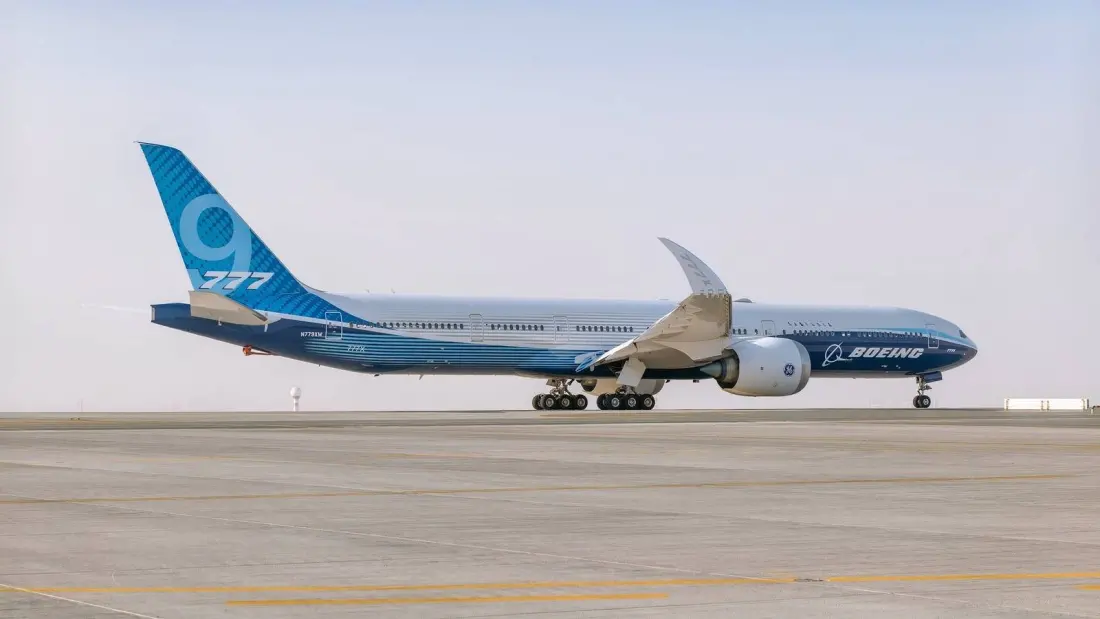
Boeing's forthcoming 777X has a party trick no other commercial airliner can match: wingtips that fold upward on the ground so the jet fits standard airport gates, then lock flat for flight. But if a flight crew ever tried to depart with those tips still folded, the aircraft would refuse to cooperate — by design, and by law.
The reason is aerodynamics. The 777X's enormous wingspan pushes tip vortices away from the fuselage, cutting drag and letting the wing generate more lift with less thrust. Fold the outer 3.5 metres (about 11 feet) vertical and that advantage evaporates: more drag, less lift, exactly what you don't want during takeoff. The folding mechanism was never built to handle the aerodynamic loads of flight in the up position either, so a folded-wing departure risks mechanical failure.
Boeing has layered safeguards to make sure it never happens. A loud takeoff warning alarm sounds if the crew advances the throttles with tips unlocked. An electronic checklist stays marked "incomplete" until the wingtips are extended and latched. And past 50 knots of ground speed, the avionics no longer permit an abort — meaning the protection has to work before the roll starts, which is why FAA and EASA certification requires it. Once extended in flight, the tips are secured by latch pins, a large mechanical bolt and electronic isolation, so they stay put even in a total power failure.
The folding system, built by Liebherr-Aerospace in Lindenberg, Germany, is a first for commercial aviation. It borrows heavily from military practice: Boeing inherited decades of naval folding-wing expertise through its 1997 McDonnell Douglas merger, which brought the F/A-18 Super Hornet programme in-house. The 777X version automates it — the tips fold themselves when ground speed drops below 50 knots after landing.
The idea isn't new. Boeing patented folding wingtips for the original 777 back in 1995, with a longer 21-foot folding section hinged closer to the wing root. Airlines balked at the weight, lost fuel capacity and maintenance burden, so it was shelved. Carbon-fibre composite wings and modern actuation finally made the concept workable, with the hinge moved outboard where structural loads are lower.
Why should passengers care? The payoff is a jet that burns roughly 10-12% less fuel than rivals and 20% less than the 747 it's meant to replace, while fitting Code E gates that the A380 can't use. Onboard, fly-by-wire Smooth Ride Technology actively dampens turbulence using hundreds of sensors, and the cabin keeps a 6,000-foot altitude, higher humidity and 40% less engine noise — all aimed at arriving less wrecked after a long-haul flight.
The catch is timing. Originally due in 2020 with launch customer Lufthansa, the 777X is now expected to reach full-rate production around 2027, with CEO Kelly Ortberg describing a "mountain of work" remaining for certification. Still, Emirates added 65 more units at the Dubai Airshow 2025, betting the 777X is the only real successor to the jumbo jet era. When it finally enters service, the folding tips will be invisible to passengers — doing exactly what they're supposed to, locked flat and forgotten.