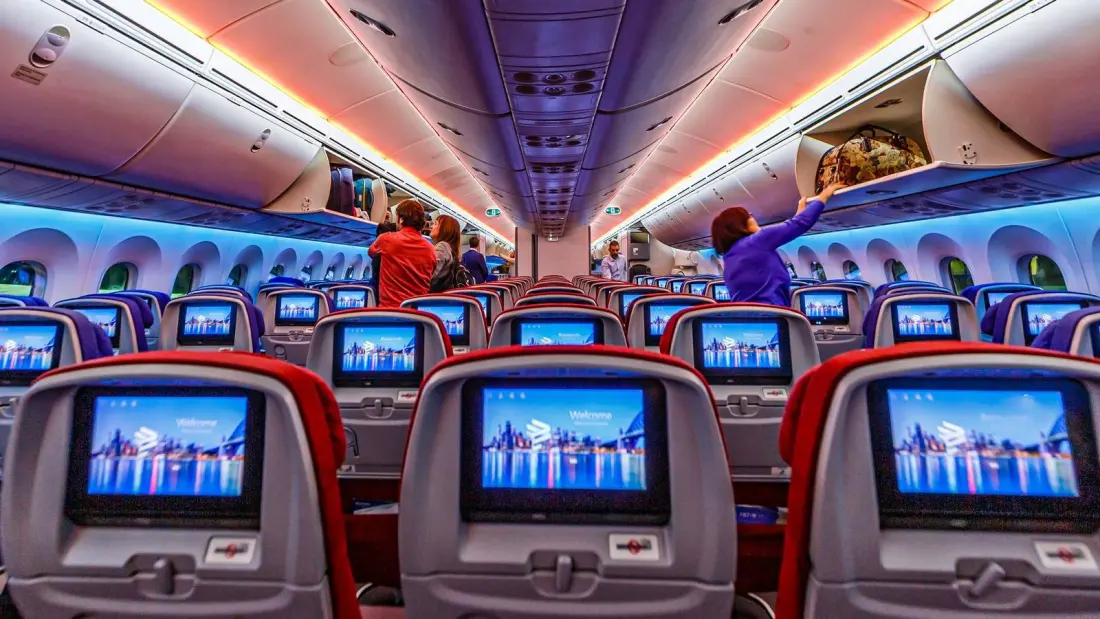
Step aboard a Boeing 787 Dreamliner and your body notices something before your brain does: the air feels different. That's not marketing fluff — it's engineering built around human physiology rather than pure fuel maths, and it's the reason the Dreamliner has become the go-to aircraft for ultra-long-haul routes.
The headline number is cabin altitude. On older aluminium jets like the 767 or A330, the cabin is pressurised to roughly 8,000 feet at cruise. The 787 holds it at around 6,000 feet, thanks to a higher pressure differential (about 9.06 psi versus the usual 8.11) that its carbon-fibre fuselage can handle without fatigue damage. The medical case is solid: research in the New England Journal of Medicine found blood oxygen saturation drops by an average of 4.4 percentage points after several hours at a simulated 8,000-foot cabin — the root of that familiar long-haul grogginess, headaches and aches. At 6,000 feet, your blood oxygen stays much closer to ground-level norms.
Then there's humidity. Conventional jets pipe in dry 'bleed' air from the engines and deliberately cap moisture below 10% to protect metal fuselages from corrosion — leaving you with dry eyes and parched sinuses. The 787's bleedless design uses electric compressors for fresh air, and since carbon fibre can't rust, it runs active humidifiers pushing relative humidity to 15–25%. Bonus: cabin air is fully separated from engine oil seals, eliminating fume events.
The windows are another giveaway. At 10.7 by 18.4 inches, they're up to 65% larger than standard, and every seat — even middles — has a line of sight to the horizon. Instead of plastic shades, Gentex electrochromic gel layers dim the glass through five opacity levels, blocking over 99.99% of visible light at the darkest setting while preserving the view. Crew can override everything from the cabin panel for takeoff and landing.
Ride quality gets the same treatment. Pressure sensors in the nose detect gusts milliseconds before they hit the wings, and the flight computers make instant counteracting control inputs, while the long carbon wings flex like leaf springs to soak up turbulence. Seats over the wing box remain the calmest spot on the plane.
But here's the catch worth knowing before you book: seat width. Boeing designed the 787's 215-inch cabin for a comfortable 8-abreast economy layout (2-4-2), which gives seats around 18.5 inches of width. Only a handful of carriers, notably Japan's ANA and JAL, kept that. Most airlines went 9-abreast (3-3-3), squeezing seats down to about 17.0–17.3 inches — tighter than the Airbus A350, whose wider cabin fits 18-inch seats even at nine abreast.
So the practical takeaway: the Dreamliner genuinely reduces jet lag, dehydration and motion sickness, and most travellers feel it when they land. But if lateral elbow room matters to you on a 12-hour flight, check the seat map — a 2-4-2 787, or an A350, will treat your shoulders far better than a dense 3-3-3.