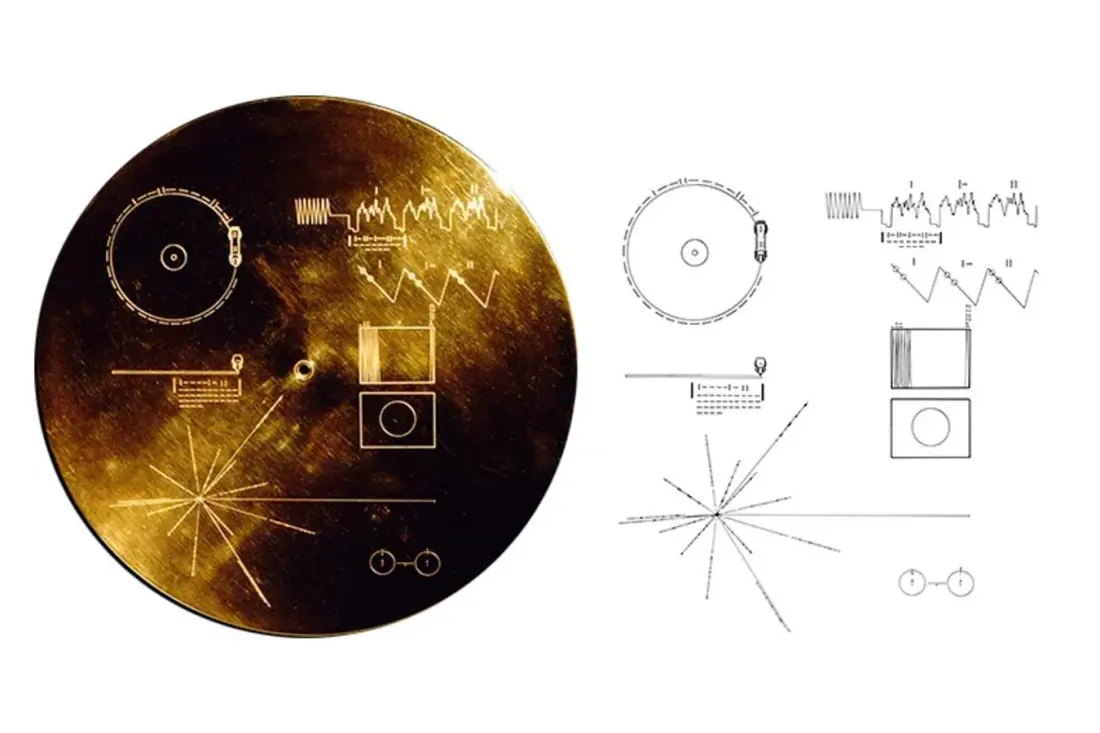
In 1977, NASA launched two spacecraft, Voyager 1 and Voyager 2, each carrying a gold-plated record packed with sounds and images from Earth. The idea was simple and ambitious at once: if something out there ever finds it, the disc should explain who we are. Nearly fifty years on, both records are still travelling, and the choices made by the team behind them remain one of the most interesting self-portraits humanity has ever produced.
The project was chaired by astronomer Carl Sagan, working with scientist Frank Drake, creative director Ann Druyan, producer Timothy Ferris, artist Jon Lomberg and Linda Salzman, who organised the greetings. Together they settled on 115 images, greetings in 55 languages, recordings of natural sounds and roughly 90 minutes of music.
The images start with the basics: diagrams of the solar system, DNA, cells, human anatomy, conception and birth. From there they widen out to dolphins, elephants, forests, deserts and oceans, then to people at work and at home — a cotton harvest, grape picking, a Chinese dinner party, an Amish construction site, a family portrait. Landmarks including the Taj Mahal, the Great Wall of China, Oxford and the Sydney Opera House sit next to a factory floor, a train, an airport and a radio telescope. There are also pointed cultural snapshots: Andean girls, a Balinese dancer, a craftsman in Thailand, Bushmen hunters, and Jane Goodall with her chimpanzees.
The audio gets more personal. The spoken greetings run from Akkadian, an ancient Mesopotamian language, to Wu, a Chinese dialect, with printed messages from US President Jimmy Carter and UN Secretary-General Kurt Waldheim. Nature recordings capture surf, wind, thunder, birds and whales. The music mixes Bach, Beethoven and Mozart with Chuck Berry's "Johnny B. Goode", Javanese traditional music, Senegalese percussion and a Pygmy girls' initiation song from what was then Zaire. And then there is the strangest track of all: a recording of Ann Druyan's own brainwaves, captured in an experiment, adding a trace of a single human mind to a disc meant to stand for billions.
What the article brings out nicely is what the record is not. It cannot cover every language, community or tradition, and its selection reflects the priorities of a small group of American scientists and artists in the 1970s. A handful of photographs cannot sum up the planet. That bias is precisely what makes the record historically revealing decades later — it preserves not just Earth, but how one team chose to describe it.
For travellers, there's an unexpected hook here: the record is essentially a curated bucket list from 1977. Its images sketch an itinerary spanning Bali, the Andes, Thailand, China, Oxford, Sydney and San Francisco's Golden Gate Bridge — a reminder of how much of the world a single disc tried to squeeze in, and how much more there is to see in person. Nothing beats experiencing the places that made the cut.