
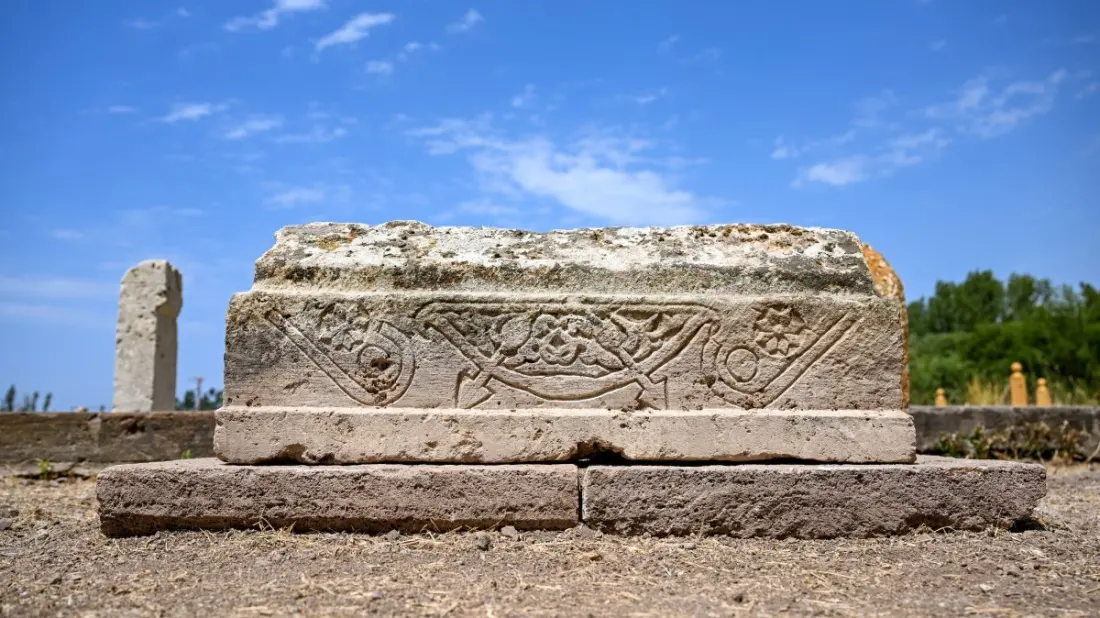
Archaeologists working at the Seljuk Cemetery in Gevaş, on the shores of Lake Van in eastern Türkiye, have unearthed a child's gravestone carved with a çovgan motif — a figure tied to an ancient horseback sport that resembles modern polo.
The stone was found buried roughly 40 centimetres deep, close to the Halime Hatun Tomb, a monument about 700 years old that anchors the site. Excavations here have been running since 2022 under Ministry of Culture and Tourism permission, led by Ercan Çalış of Van Yüzüncü Yıl University with a 15-person team spanning art history, archaeology, epigraphy, architecture and restoration.
The cemetery is one of Anatolia's largest historic Turkish-Islamic burial grounds, covering around 50 decares and holding more than 1,000 identified gravestones, some standing 2.5 metres tall and covered in inscriptions and traditional carvings. The team works methodically in 10-by-10-metre grids, removing soil layer by layer — this particular stone took about a day and a half to free.
Çovgan was more than entertainment. Played on horseback with long sticks used to strike a ball, it trained children and young people in riding, agility and combat skills. Çalış argues the motif's presence on children's graves suggests the game doubled as early warrior training, comparing it to the Ottoman practice of educating princes from a young age. It's the second çovgan-decorated gravestone found at the site this year, and both belonged to children or young people — a pattern the team reads as evidence of how the motif migrated from a living sport into funerary art. For Çalış, the motif also matters because it represents a cultural thread carried from Central Asia into Anatolia.
Gevaş stands out among historic Turkish cemeteries for the richness and variety of its decoration. The candlestick motif, rarely seen elsewhere, appears here systematically in multiple forms, making the site a kind of open-air archive of Seljuk-era symbolism.
For travellers, this is a good reason to look past Van's famous breakfasts and castle and head to its quieter southern shore. The Gevaş cemetery, with the Halime Hatun Tomb at its centre, offers a rare close-up of medieval Seljuk stone carving still being actively excavated — and new finds like this one are being made each season. Combine it with Lake Van's shoreline, Akdamar Island's Armenian cathedral nearby, and the city's legendary breakfast culture for an underrated eastern Türkiye itinerary.
Story via Daily Sabah Travel.