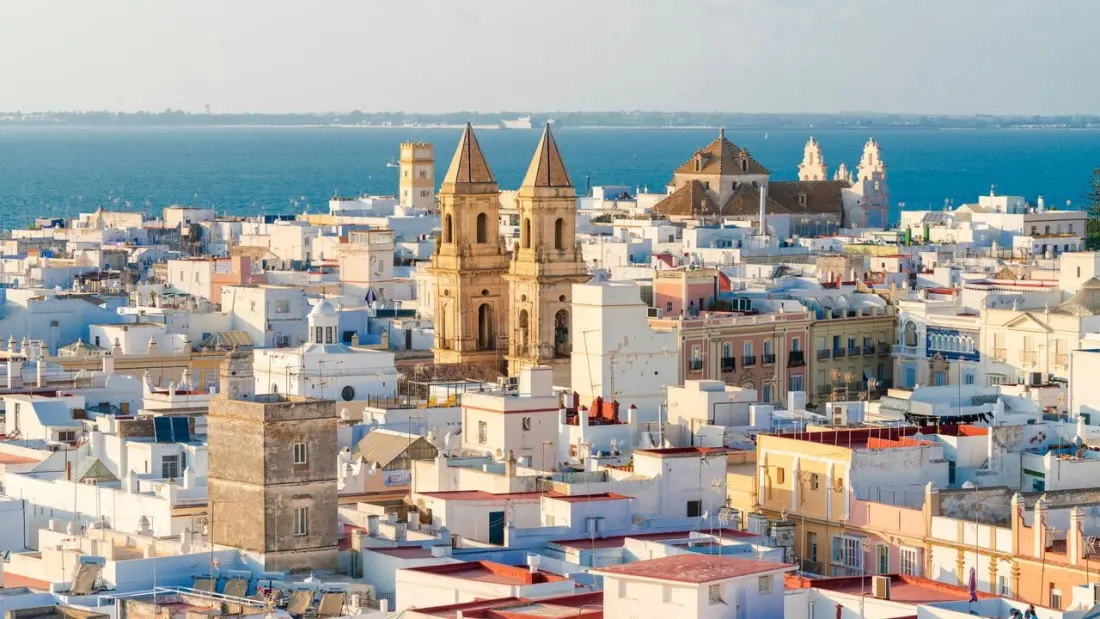
San Sebastián gets the Michelin headlines, but southern Spain has a food city that's been quietly doing its thing for roughly 3,000 years. Cádiz — founded by the Phoenicians as Gadir around 1200 B.C. and widely considered western Europe's oldest continuously inhabited city — sits on a sandy peninsula at the edge of the Atlantic, all pastel buildings softened by salt air (locals call it "Spain's little Havana") and a golden horseshoe beach called La Caleta in the old town.
The province around it punches hard. Chef Ángel León's Aponiente in Puerto de Santa María became Andalusia's first three-Michelin-star restaurant, and Jerez de la Frontera — all historic bodegas and lively tabancos — was recently voted Spain's capital of gastronomy. Nearby Sanlúcar de Barrameda pours its bone-dry manzanilla sherry alongside plates of langoustines, while Barbate lands bluefin tuna so prized that around 70 percent is exported to Japan, caught with almadraba net techniques the Phoenicians pioneered.
In the city itself, start at Mercado de Abastos, one of Spain's oldest food markets (1838), where locals haggle over shellfish and gulls the size of small dogs circle overhead. A local trick: buy a fish from Marisco Camilo inside the market and carry it to neighbouring Bar Carrusel, which will fry it up for just the cover charge while you order cañas and olives.
The La Viña neighbourhood is the eating epicentre. Casa Manteca, open since 1953, is the classic — bullfighting photos on the walls, sherry bottles gathering dust, and two essential plates: cold-served chicharrones with lemon, and tortillitas de camarón, lace-crisp chickpea fritters packed with tiny brine shrimp. El Faro, on the barrio's edge, does quick tapas at a marble bar or full white-tablecloth seafood meals; its tortilla de camarones is a regional benchmark. For fried fish the way locals eat it, hit a freiduría like Freiduría Las Flores for paper-wrapped battered cuttlefish.
There's fine dining too: Dutch chef León Griffioen and his wife Paqui Márquez won Cádiz city its first Michelin star in 2023 at Código de Barra, with tasting menus built on retinto beef and almadraba tuna. For sherry, the 1932-era Taberna La Manzanilla pours amontillado and manzanilla from century-old casks, tabs still chalked on the bar top — ask nicely and they may show you the secret storage room. And for dessert, Venice-born Carlo Guerriero of La Cremería Gelato Italiano ranked number one in the world in the 2026 Gelato Festival World Ranking; his Sherrymisú, a tiramisù made with Jerez wine, is the signature.
Cádiz suits travellers who like their food culture lived-in rather than staged: markets, taverns and fried-fish counters rather than queues. It pairs naturally with Seville or Jerez, and the sherry triangle makes an easy road trip. Go hungry, walk everywhere, and let the market dictate lunch.